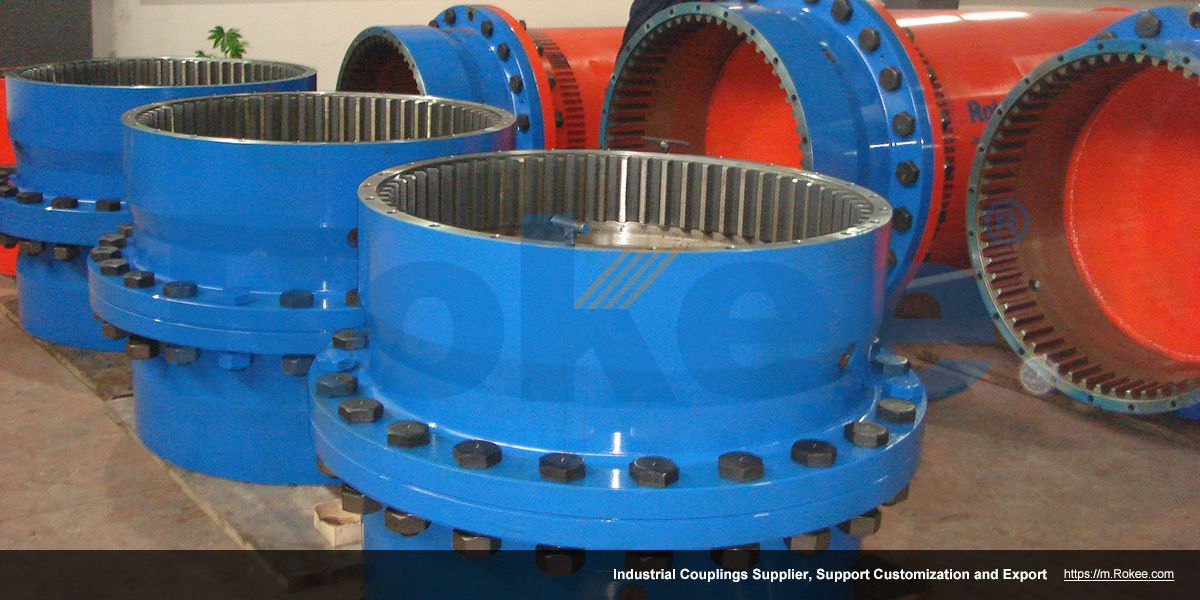
Drum Gear Couplings
The Curved-tooth Gear Coupling is a specially designed advanced gear coupling. Its outer teeth are made into a sphere, with the center of the sphere on the axis of the gear. The teeth clearance is slightly larger than the general products and can transfer a greater torque and allow greater angular displacement, enjoying excellent performance and longer life.
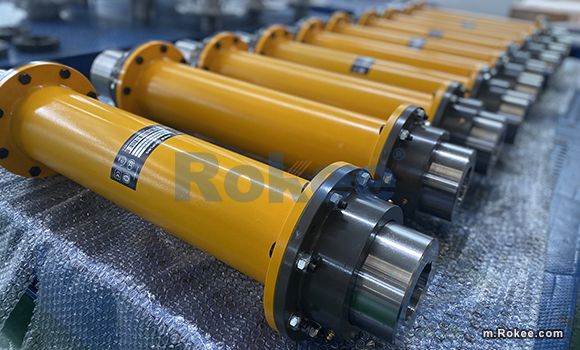
ROD Drum Gear Coupling is one of the transmission products with core technology independently developed by Rokee and has established and reported corporate technical standards in the country. By combining with the standard coupling technology of advanced countries such as Japan and Germany, we optimized many detailed dimensions, and adopted the toothed design with a large pressure angle and short shaft design for the shaft hole, which reduces the length-diameter ratio, and has a more compact structure and excellent speed performance. The bolts of similar types are standardized and the parts are universal. Compared with the national standard couplings, our standard couplings can transfer more torque, with greatly reduced mass and small moment of inertia. It meets the European explosion-proof requirements and the comprehensive performance is greatly advanced. We highly recommend you to choose our products for better transmission performance.

Model of Rokee Standard Drum Gear Couplings
- RODA Basic Drum Gear Coupling
- RODT Drum Gear Coupling With Intermediate Tube
- RODX Drum Gear Coupling With Intermediate Shaft
- RODP Drum Gear Coupling With Brake Disc
- RODF Drum Gear Coupling With Split Brake Discs
- RODW Drum Gear Coupling With Brake Wheel
- RODU Drum Gear Coupling With Brake Wheel
- RODV Vertical Installation Drum Gear Coupling
- RODM Torsion Protection Drum Gear Coupling
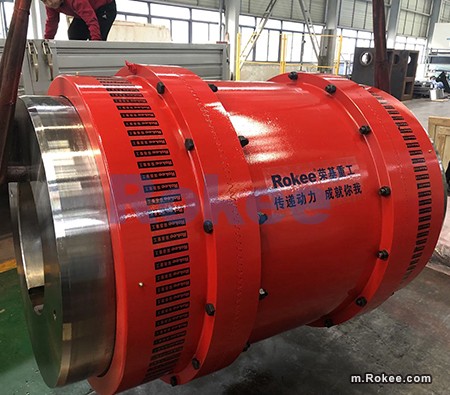
Chinese National Standard Drum Gear Couplings
- GICL Wide Type Drum Gear Coupling
- GICLZ Drum Gear Coupling With Intermediate Shaft
- GIICL Narrow Type Drum Gear Coupling
- GIICLZ Drum Gear Coupling With Intermediate Shaft
- GCLD Drum Gear Coupling For Motor
- NGCL Drum Gear Coupling With Brake Wheel
- NGCLZ Drum Gear Coupling With Brake Wheel
- WG Drum Gear Coupling
- WGZ Drum Gear Coupling With Brake Wheel
- WGP Drum Gear Coupling With Brake Discs
- WGT Drum Gear Coupling With Indirect Tube
- WGC Vertical Installation Drum Gear Coupling
- WGJ Drum Gear Coupling With Intermediate Shaft
Drum gear coupling is a rigid flexible coupling device, which belongs to the advanced form of gear coupling. Through its unique drum shaped gear design, it exhibits excellent performance in the field of industrial transmission. This type of coupling consists of an inner ring gear with the same number of teeth and a flange half coupling with outer teeth. Its most prominent feature is the arc-shaped spherical design of the tooth top and tooth surface of the outer gear shaft sleeve, which enables it to compensate for radial, axial, and angular axis deviations. Compared with traditional CL type spur gear couplings, Drum tooth couplings have a series of outstanding advantages such as compact structure, small turning radius, large load-bearing capacity, high transmission efficiency (up to 99.7%), low noise, and long maintenance cycle.
From a classification perspective, drum toothed couplings belong to the movable type of rigid couplings and have a certain degree of flexibility compensation capability. It is particularly suitable for low-speed heavy-duty working conditions and has wide applications in metallurgy, mining, lifting and transportation industries. It is also suitable for shaft transmission of various types of machinery such as petroleum, chemical, and general machinery. With the development of industrial technology, Drum gear couplings have gradually replaced traditional spur gear couplings and become the preferred device in the field of heavy-duty transmission.


The core structure of the Drum toothed coupling is relatively simple but exquisitely designed, mainly composed of the following key components:
- Internal gear ring: It is usually a ring-shaped structure with involute straight teeth machined on the inner circumference. The material is mostly made of high-quality alloy steel such as 42CrMo, which is carburized and quenched to improve the tooth surface hardness (HRC50-60) and wear resistance.
- External gear shaft sleeve: The outer circumference of the shaft sleeve is designed with drum shaped teeth, and both the tooth tip and tooth surface are spherical arcs. The center of the spherical surface is located on the gear axis. This design results in a larger backlash between the teeth compared to regular gears, and the material is usually alloy steel such as 20CrMnTi.
- Sealed end cap: used to maintain the sealing of lubricant and prevent contaminants from entering the mating area. The high-end model adopts an integrated sealing structure to improve the sealing effect.
- Connecting bolts: used to connect the half coupling with the equipment shaft end, and some models also include additional components such as intermediate sleeves or brake wheels.
The working principle of the crown gear coupling is based on the precise meshing of the inner and outer teeth to transmit torque. When the driving shaft rotates, power is transmitted to the driven shaft through the meshing of the outer gear sleeve and the inner gear ring. Due to the special design of the drum shaped teeth, the tooth surface can maintain good contact when there is relative displacement between the two axes (including radial, axial, and angular deviations):
- Radial compensation: achieved through the design of tooth flank clearance and tooth crest arc, the allowable radial displacement depends on the modulus and number of teeth.
- Axial compensation: The spherical characteristics of the drum shaped teeth allow for a certain degree of relative sliding between the inner and outer teeth in the axial direction.
- Angular compensation: The allowable angular displacement of the crown tooth coupling can reach 1 ° 30 ′, which is 50% higher than that of the straight gear coupling. This is one of its most prominent advantages.
During the working process, the inner and outer tooth surfaces will experience periodic axial sliding due to relative displacement, so good lubrication is crucial for reducing wear. Thin oil lubrication can reduce wear to about 10% of grease lubrication, while also taking away the heat generated by meshing to prevent material performance degradation.
There are various types of crown toothed couplings, which have formed a complete series of product systems to meet the needs of different industrial scenarios. According to their structural and functional characteristics, they can be mainly divided into the following types:
- Basic types: including GICL (light) and GIICL (heavy) series, which are the most widely used universal couplings. GIICL type is divided into Type I and Type II. Type I adopts a separated sealing end, allowing for larger radial displacement; Type II is an integral sealed end with a more compact structure.
- Special functional type:
WGP type: Curved-tooth Gear Coupling with brake disc, suitable for equipment that requires braking function such as cranes.
WGZ type: with brake wheel structure, market price is about 500-620 yuan, mainly used for instruments and equipment.
WGC type: a model specifically designed for vertical installation, suitable for equipment such as vertical pumps.
WGT type: connected to a middle sleeve structure, used for long wheelbase transmission.
TGL type: using nylon inner gear ring, with buffering and vibration reduction effect. - Industry specific types: such as NGCL type (heavy-duty with brake wheels) and WGJ type (intermediate shaft type), developed for specific industry needs.


From the specification parameters, the coverage range of Curved tooth Couplings is extremely wide:
Nominal torque: ranging from 0.4kN · m (small equipment) to 4500kN · m (heavy machinery), some models can reach 8.19 million Newton meters.
Shaft hole diameter: Standard products cover 16mm to 1200mm, which can meet different shaft diameter requirements.
Allowable speed: Depending on the model, from 460r/min to 4000r/min, high-precision dynamic balancing models can be used in high-speed applications such as gas turbines.
These couplings are mostly manufactured according to industry standards, such as JB/T 8854 (GICL/GIICL series), JB/T 7001 (WGP type), JB/ZQ 4186 (WG type), etc., ensuring the interchangeability and reliability of the products. Manufacturers also have various non-standard design capabilities and can customize coupling sizes and performance parameters according to users' special needs.
The drum gear coupling with its unique design, exhibits outstanding performance in various aspects in the transmission field, making it an ideal choice for heavy-duty transmission:
- Excellent load-bearing capacity: Under the same external dimensions, the load-bearing capacity of the drum toothed coupling is on average 15-20% higher than that of the straight toothed coupling. This is due to the optimization of load distribution by the drum shaped teeth, which avoids the stress concentration phenomenon at the tooth end of the straight tooth coupling. After using high-quality alloy steel (such as 42CrMo) and carburizing quenching treatment, the tooth surface hardness can reach HRC50-60, further improving the bearing capacity and wear resistance.
- Excellent displacement compensation capability: The curved gear coupling performs well in terms of axis alignment deviation:
Angular compensation: The allowable angular displacement is up to 1 ° 30 ′, which is 50% higher than the 1 ° of a spur gear coupling.
Radial compensation: achieved by increasing the tooth flank clearance, the specific value depends on the modulus and number of teeth.
Axial compensation: Some models allow axial displacement up to ± 5mm or even greater. - Efficient transmission performance: The transmission efficiency is as high as 99.7%, with minimal energy loss. The drum shaped tooth surface improves the contact conditions between the inner and outer teeth, avoids the edge compression of straight teeth, optimizes the friction condition of the tooth surface, and reduces operating noise (usually 3-5 decibels lower than straight teeth).
- Long service life: The Drum gear coupling adopts forced thin oil lubrication, and its tooth surface wear is only about 10% of that of grease lubrication. Circulating lubricating oil can not only reduce wear, but also take away the heat generated by meshing, preventing material performance degradation. Under normal operating conditions, the service life can reach 2-3 times that of a straight tooth type.
- Convenient maintenance feature: The outer gear sleeve has a trumpet shaped tooth end, making it very easy to assemble and disassemble the inner and outer teeth. Some models adopt modular design, which allows for quick replacement of vulnerable parts without the need to move the entire equipment, greatly reducing maintenance downtime.
These performance characteristics make the Drum gear coupling the preferred choice in the heavy industry field, especially in working conditions with shaft alignment deviation. It can effectively reduce the additional load on bearings and shafts, and extend the service life of the entire transmission system.
The core of drum tooth design lies in the determination of the drum curvature curve. Drum curve refers to a virtual curve formed by the gradual phase change of non conjugate tooth surfaces from different end sections, which directly affects the compensation ability of the coupling and the contact state of the tooth surface. There are two basic requirements that need to be met during design:
- Avoid edge contact: At the maximum axial inclination angle, the tooth surface should maintain surface contact instead of edge contact to prevent stress concentration.
- Optimize load distribution: The radius of the bulge circle should be as large as possible (the curvature radius is proportional to the thinning amount of the inner teeth) to reduce the contact stress on the tooth surface. Generally, the radius of a drum circle is related to the modulus, with commonly used values being 8-15 times the modulus.
Drum curves are often designed with single or multiple arcs. Single arc is simple and easy to process, while three-stage arc design can better optimize the distribution of contact stress. The center of the bulge circle can be located on the gear axis or offset by a certain distance to further improve the stress state.
In the realm of mechanical transmission systems, couplings serve as indispensable components that bridge rotating shafts, enabling the seamless transfer of torque while accommodating various forms of misalignment. Among the diverse array of couplings available, gear couplings stand out for their robustness, high torque-carrying capacity, and ability to tolerate significant misalignments, making them ideal for heavy-duty industrial applications. Within the category of gear couplings, two prominent types have garnered widespread attention and utilization: Curved-tooth Gear Couplings and Drum Gear Couplings. While both belong to the gear coupling family and share core functionalities, they exhibit distinct structural designs, performance characteristics, and application suitability.
To begin with, it is essential to establish a foundational understanding of gear couplings as a whole, as this provides the context for appreciating the unique features of Curved-tooth and Drum Gear Couplings. Gear couplings operate on the principle of meshing gear teeth between two rotating components to transmit torque. Unlike flexible couplings that rely on elastic elements for misalignment compensation, gear couplings utilize the sliding and meshing of gear teeth to accommodate angular, parallel, and axial misalignments. This design inherent to gear couplings endows them with superior torque transmission capabilities compared to many other coupling types, making them well-suited for applications involving high power, high speed, and heavy loads, such as in steel mills, mining equipment, power generation units, and large-scale industrial machinery. The basic structure of a typical gear coupling consists of two gear hubs, which are connected to the respective shafts via keys or interference fits, and an outer sleeve (or two half-sleeves) that meshes with the gear hubs. The meshing gear teeth are usually lubricated to reduce friction, wear, and noise, thereby extending the service life of the coupling. Curved-tooth Gear Couplings and Drum Gear Couplings build upon this basic structure but incorporate unique modifications to their gear tooth profiles and configurations, resulting in differences in performance and application scope.
Curved tooth Couplings, as the name suggests, are characterized by their curved tooth profiles, which distinguish them from the straight-tooth counterparts commonly found in basic gear couplings. The curved teeth of these couplings are typically designed with a circular arc profile, which significantly alters the nature of the meshing process compared to straight teeth. One of the key structural features of Curved-tooth Gear Couplings is the point contact (or line contact with a small contact area) between the meshing teeth during operation. This curved tooth design is not arbitrary; it is meticulously engineered to optimize the coupling's performance in specific operating conditions. The curvature of the teeth allows for a more gradual and smooth meshing process, reducing the impact loads that occur during the engagement of gear teeth. In contrast, straight-tooth gear couplings often experience higher impact loads due to the sudden contact between the straight tooth surfaces, which can lead to increased wear and noise over time. The curved tooth profile also enables the coupling to accommodate greater angular misalignment. This is because the curved teeth have a larger contact range, allowing for more relative movement between the meshing components without compromising the integrity of the torque transmission. Additionally, the curved design distributes the transmitted torque more evenly across the tooth surface, reducing the stress concentration on individual teeth and enhancing the overall load-carrying capacity of the coupling.


The working principle of Curved toothed Couplings revolves around the meshing of the curved teeth on the gear hubs with the internal teeth of the outer sleeve. When torque is applied to one of the shafts, the gear hub connected to that shaft rotates, and the curved teeth engage with the internal teeth of the sleeve, transferring the torque to the other gear hub and subsequently to the second shaft. During this process, any angular misalignment between the two shafts is compensated for by the sliding of the curved teeth along the surface of the sleeve's internal teeth. The curved profile ensures that even as the shafts angle relative to each other, the contact between the teeth remains consistent, maintaining a reliable torque transfer. Similarly, parallel misalignment is accommodated by the radial movement of the gear hubs within the sleeve, with the curved teeth allowing for this movement without excessive friction or wear. Axial misalignment, which refers to the relative axial displacement of the two shafts, is also handled by the Curved-tooth Gear Coupling through the axial sliding of the teeth within the sleeve. The lubrication system, which is crucial for the smooth operation of Curved-tooth Gear Couplings, ensures that the meshing teeth slide against each other with minimal friction, reducing wear and preventing overheating. Common lubricants used include industrial gear oils with high viscosity and anti-wear additives, which are selected based on the operating temperature, load, and speed of the coupling.
Moving on to Crown Gear Couplings, these couplings are distinguished by their drum-shaped gear tooth profile, which is another variation of the gear coupling design. The drum-shaped teeth are characterized by a convex curvature along the length of the tooth, giving the gear a drum-like appearance. This structural design is aimed at addressing specific challenges associated with misalignment and load distribution in heavy-duty applications. One of the key structural differences between Drum Gear Couplings and Curved-tooth Gear Couplings lies in the nature of the tooth contact. While Curved-tooth Gear Couplings typically have point or small line contact, Drum Gear Couplings feature a longer line contact between the meshing teeth. This longer contact line is a result of the drum-shaped profile, which allows for a larger area of contact between the teeth, distributing the torque over a greater surface area. This distribution of torque reduces the stress on individual teeth, making Drum Gear Couplings particularly well-suited for extremely high torque applications where stress concentration is a major concern.
The working principle of Drum Gear Couplings is similar to that of Curved-tooth Gear Couplings in that torque is transmitted through the meshing of gear teeth between the hubs and the outer sleeve. However, the drum-shaped tooth profile enhances the coupling's ability to accommodate misalignments, especially angular and parallel misalignments. When the shafts are misaligned, the drum-shaped teeth slide along the internal teeth of the sleeve, and the convex curvature ensures that the contact line between the teeth remains intact, maintaining efficient torque transmission. The longer contact line also contributes to the coupling's stability during operation, reducing vibration and noise. Like Curved-tooth Gear Couplings, Drum Gear Couplings require proper lubrication to minimize friction and wear between the meshing teeth. The lubricant not only reduces friction but also helps to dissipate heat generated during operation, preventing thermal damage to the coupling components. In some high-speed or high-temperature applications, forced lubrication systems may be employed to ensure a continuous supply of lubricant to the meshing teeth, further enhancing the reliability and service life of the coupling.
When comparing the performance characteristics of teeth Couplings and Drum Gear Couplings, several key differences emerge, each making them suitable for specific application scenarios. One of the primary performance differences is in their torque-carrying capacity. While both couplings are designed for heavy-duty applications, Drum Gear Couplings generally have a higher torque-carrying capacity due to their longer tooth contact line, which distributes the load more evenly. This makes Drum Gear Couplings the preferred choice for applications involving extremely high torque, such as in large-scale mining machinery, cement kilns, and heavy-duty rolling mills. On the other hand, Curved-tooth Gear Couplings excel in applications where moderate to high torque is required, and a higher degree of misalignment accommodation is necessary. The curved tooth profile allows for greater angular misalignment (typically up to 1.5 to 2 degrees) compared to Drum Gear Couplings (which usually accommodate up to 1 to 1.5 degrees), making them suitable for applications where shaft misalignment is more pronounced, such as in some types of pumps, compressors, and medium-sized industrial gearboxes.
Another important performance characteristic to consider is the operating speed range. Both Curved-tooth and Drum Gear Couplings can operate at high speeds, but their suitability for different speed ranges varies based on their design. Curved-tooth Gear Couplings, with their point or small line contact, generate less friction and heat at high speeds compared to Drum Gear Couplings, which have a larger contact area. This makes Curved-tooth Gear Couplings more suitable for high-speed applications, such as in power generation units (e.g., steam turbines, gas turbines) where rotational speeds can reach several thousand revolutions per minute. Drum Gear Couplings, while capable of high-speed operation, are more commonly used in medium to high-speed applications where high torque is the primary requirement. Noise and vibration levels are also important performance metrics, especially in industrial environments where noise pollution is a concern. Curved-tooth Gear Couplings, due to their smooth meshing process, tend to operate with lower noise and vibration levels compared to Drum Gear Couplings. The gradual engagement of the curved teeth reduces impact loads, minimizing the generation of noise and vibration. Drum Gear Couplings, with their longer contact line, may produce slightly higher noise levels, but this is often offset by their superior stability and torque-carrying capacity in heavy-duty applications.
The application scenarios of Curved tooth Gear Couplings and Drum Gear Couplings are largely determined by their performance characteristics. Curved-tooth Gear Couplings find extensive use in a wide range of industrial applications, including but not limited to, power generation, chemical processing, petroleum refining, and general machinery. In power generation plants, they are used to connect turbines to generators, where high speed and moderate misalignment are common. In chemical and petroleum processing facilities, they are employed in pumps, compressors, and agitators, where reliable torque transmission and resistance to harsh operating conditions are essential. Additionally, Curved-tooth Gear Couplings are used in medium-sized rolling mills, conveyors, and material handling equipment, where they can accommodate the misalignments that occur due to the dynamic nature of the operation. The versatility of Curved-tooth Gear Couplings stems from their balanced combination of torque-carrying capacity, misalignment accommodation, and high-speed performance.
Drum Gear Couplings, on the other hand, are primarily utilized in extremely heavy-duty applications where high torque is the dominant requirement. One of the most common applications of Drum Gear Couplings is in the mining industry, where they are used to connect the output shafts of large mining trucks, excavators, and crushers to their respective drive systems. These applications involve extremely high torque loads and require a coupling that can withstand the harsh operating conditions, including dust, vibration, and frequent misalignments. Another major application area for Drum Gear Couplings is in the steel industry, specifically in heavy-duty rolling mills, where they are used to transmit torque between the motor and the rolling stands. The high torque-carrying capacity of Drum Gear Couplings ensures that the rolling mills can operate efficiently even under the extreme loads encountered during the rolling of thick steel plates. Additionally, Drum Gear Couplings are used in cement kilns, large-scale mixers, and marine propulsion systems, where their robustness and reliability make them well-suited for the demanding operating conditions.
Proper installation and maintenance are crucial for ensuring the optimal performance and long service life of both Curved-tooth Gear Couplings and Drum Gear Couplings. The installation process for these couplings involves several key steps, including shaft preparation, alignment, assembly, and lubrication. Shaft preparation involves ensuring that the shaft surfaces are clean, free of burrs, and have the correct dimensions for a proper fit with the gear hubs. The hubs are typically installed onto the shafts using interference fits or keyed connections, and it is essential to ensure that the hubs are properly seated to prevent slippage during operation. Alignment is perhaps the most critical step in the installation process, as improper alignment can lead to excessive wear, noise, vibration, and premature failure of the coupling. Both angular and parallel misalignments should be minimized to within the manufacturer's recommended limits. Specialized alignment tools, such as laser alignment systems, are often used to achieve precise alignment, especially in high-speed and high-torque applications.


Assembly of the coupling involves connecting the gear hubs to the outer sleeve. For Curved-tooth Gear Couplings, the curved teeth must be properly engaged with the internal teeth of the sleeve to ensure smooth operation. For Drum Gear Couplings, the drum-shaped teeth must be aligned correctly to achieve the proper line contact. Lubrication is the final step in the installation process, and it is essential to use the correct type and amount of lubricant. The lubricant should be applied evenly to all meshing surfaces, and the coupling should be checked for any leaks before operation. Regular maintenance is also necessary to keep the couplings in good working condition. This includes periodic inspections of the gear teeth for wear, cracks, or damage; checking the lubricant level and quality; and re-aligning the shafts if necessary. Wear on the gear teeth can be detected by measuring the tooth thickness or by visual inspection, and any damaged teeth should be repaired or replaced promptly to prevent further damage to the coupling. The lubricant should be changed at regular intervals, as specified by the manufacturer, to ensure that it maintains its lubricating properties. Additionally, the coupling should be cleaned regularly to remove dirt, dust, and other contaminants that can accumulate on the gear teeth and affect performance.
The materials used in the construction of Curved-tooth Gear Couplings and Drum Gear Couplings play a significant role in their performance, durability, and resistance to harsh operating conditions. Both types of couplings are typically made from high-strength alloy steels, which offer excellent mechanical properties, including high tensile strength, fatigue resistance, and wear resistance. Common alloy steels used include 40Cr, 45CrNiMoV, and 20CrMnTi, which are heat-treated to enhance their hardness and toughness. The heat treatment process, which may include quenching and tempering, ensures that the gear teeth can withstand the high stresses and loads encountered during operation. In some applications where corrosion resistance is a concern, such as in marine or chemical environments, the coupling components may be coated with anti-corrosion materials, such as chrome plating or paint, or made from stainless steel. However, stainless steel is generally less strong than alloy steel, so it is only used in applications where corrosion resistance is more important than high torque-carrying capacity.
Looking towards the future, the development of Curved tooth Gear Couplings and Drum Gear Couplings is likely to be driven by several key trends in the mechanical engineering industry, including the demand for higher efficiency, greater reliability, and improved sustainability. One of the main areas of development is the optimization of the gear tooth profiles using advanced computational tools, such as finite element analysis (FEA) and computer-aided design (CAD). These tools allow engineers to design tooth profiles that further enhance load distribution, reduce stress concentration, and improve misalignment accommodation. For example, the use of FEA can help to simulate the meshing process of the gear teeth under various operating conditions, enabling the identification of potential weak points and the optimization of the tooth profile to increase durability. Another trend is the integration of smart technologies into couplings, such as sensors for monitoring temperature, vibration, and wear. These sensors can provide real-time data on the condition of the coupling, allowing for predictive maintenance and reducing the risk of unexpected failures. Predictive maintenance not only extends the service life of the coupling but also reduces downtime and maintenance costs, making it particularly beneficial for industrial applications where productivity is critical.
Sustainability is also becoming an increasingly important consideration in the design and manufacturing of couplings. This includes the use of more environmentally friendly materials and lubricants, as well as the design of couplings that are more energy-efficient. For example, the development of low-friction gear tooth profiles can reduce energy loss during torque transmission, improving the overall efficiency of the mechanical system. Additionally, the use of recyclable materials in the construction of couplings can reduce their environmental impact at the end of their service life. Another area of future development is the miniaturization of couplings, as mechanical systems become more compact and lightweight. This requires the design of Curved-tooth and Drum Gear Couplings that maintain their high torque-carrying capacity and misalignment accommodation while being smaller and lighter in weight. Advances in material science, such as the development of high-strength, lightweight alloys, are likely to play a key role in enabling this miniaturization.
In conclusion, Curved tooth Couplings and Crown Gear Couplings are two vital types of gear couplings that play a crucial role in modern mechanical transmission systems. While they share the core functionality of transmitting torque and accommodating misalignments, their unique structural designs result in distinct performance characteristics that make them suitable for different application scenarios. Curved-tooth Gear Couplings, with their curved tooth profiles, excel in applications requiring moderate to high torque, high speed, and greater misalignment accommodation, while Drum Gear Couplings, with their drum-shaped teeth, are ideal for extremely high torque applications in heavy-duty industries. Proper installation, maintenance, and the use of high-quality materials are essential for ensuring the optimal performance and long service life of both coupling types. As the mechanical engineering industry continues to evolve, the future of Curved-tooth and Drum Gear Couplings lies in the optimization of their designs, the integration of smart technologies, and the adoption of sustainable practices, which will further enhance their efficiency, reliability, and environmental performance. By understanding the unique features and applications of these two coupling types, engineers and industry professionals can make informed decisions when selecting couplings for their specific mechanical systems, ensuring optimal performance, reliability, and cost-effectiveness.