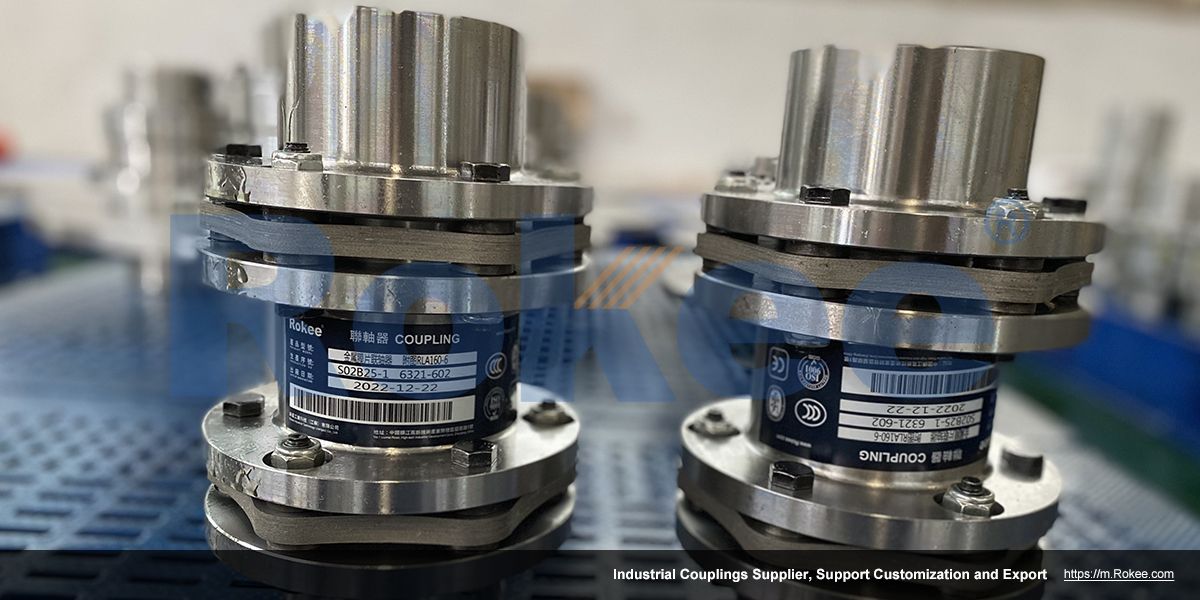
Diaphragm Couplings
Steel Laminae Coupling is a kind of high-performance metal flexible coupling, which compensates axial and angular displacements by the deformation of elastic diaphragm while transferring torque. It features with compact structure, large transmission torque, long service life, maintenance-free, high temperature resistance, acid and alkali resistance, and corrosion resistance, suitable for shafting transmission in high temperature, high speed and corrosive environment.
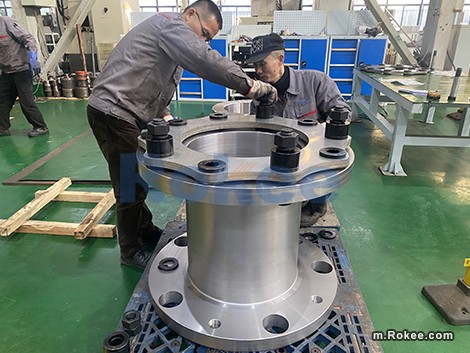
Rokee's RL series Metal Diaphragm Couplings are independently developed on the basis of high-quality products from Europe and Japan. It has smaller volume, larger torque of the same type, more reasonable proportioning size, large compensation range, light weight and small moment of inertia. Special elastic gasket design is adopted in the hole connection part of bolt and diaphragm group, which greatly reduces the stress concentration in the hole edge part, eliminates the tear loss of diaphragm, and extends the service life. With modular design, the coupling assembly is simple and its maintenance and replacement are quick. The performance far exceeds the national standard JM series products, which are widely used in fan systems, steam turbine units and other important industrial fields.
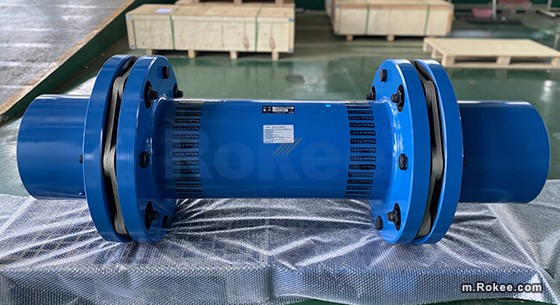
Model of Rokee Standard Diaphragm Couplings
- RLM Standard Single Section Small Metal Diaphragm Coupling
- RLMD Standard Double Section Small Metal Diaphragm Coupling
- RLA Standard Single Section Metal Diaphragm Coupling
- RLAD Standard Double Section Metal Diaphragm Coupling
- RLAR Single Shaft Sleeve Reverse-mounting Metal Diaphragm Coupling
- RLARD Double Shaft Sleeve Reverse-mounting Metal Diaphragm Coupling
- RLAF Large & Small Shaft Mounted Metal Diaphragm Coupling
- RLAT Super Long Wheelbase Metal Diaphragm Coupling
- RLQA No Flange Quick Installation Metal Diaphragm Coupling
- RLQF Flange Type Quick Installation Metal Diaphragm Coupling
- RLQU Improved Flange Quick Installation Metal Diaphragm Coupling
- RLHD High Speed Metal Diaphragm Coupling
Model of Chinese National Standard Diaphragm Couplings
Steel Laminae Coupling is a metal elastic element flexible coupling, which is composed of several sets of stainless steel thin plate diaphragms connected to the two halves of the coupling in a staggered manner with bolts. Each group of membranes is composed of several stacked pieces, divided into linkage type and integral pieces of different shapes. This type of coupling relies on the elastic deformation of the diaphragm to compensate for the relative displacement of the two shafts connected, achieving lubrication free, wear free, and high-precision power transmission.
Compared with traditional couplings, shim pack couplings have the characteristics of compact structure, high strength, and long service life. At the same time, they have no rotational clearance and are not affected by temperature and oil pollution. Its acid resistance, alkali resistance, and corrosion resistance make it particularly suitable for working environments with high temperatures, high speeds, and corrosive media. According to the mechanical industry standard JB/T 9147-1999, diaphragm couplings have been standardized in domestic industrial production and gradually replaced many traditional coupling applications.
The core advantage of the diaphragm coupling lies in its perfect balance between rigidity and flexibility - it can accurately transmit torque and speed, and compensate for various installation deviations, making it perform well in precision transmission and heavy-duty conditions.
The basic structure of diaphragm couplings is relatively simple but extremely precise. Composed of at least one diaphragm and two shaft sleeves, the diaphragm is fastened to the shaft sleeve by a pin, usually without loosening or causing backlash between the diaphragm and the shaft sleeve. The common configurations on the market include single diaphragm, double diaphragm, and triple diaphragm structures, which may contain one or two rigid components in the middle and are connected to shaft sleeves on both sides.
There is a significant difference in the ability to handle deviations between single diaphragm and double diaphragm couplings. Single diaphragm couplings are not suitable for large eccentricities due to the complex bending of the diaphragm required; The two sets of diaphragms of the double diaphragm coupling can bend in different directions simultaneously, thus better compensating for eccentricity deviation. This characteristic is similar to bellows couplings, but diaphragm couplings typically have higher torque rigidity.
The diaphragm itself is very thin (usually made of stainless steel), and can easily bend when relative displacement loads are generated. It can withstand deviations of up to 1.5 degrees and generate lower bearing loads in the servo system. This exquisite design also brings a certain degree of vulnerability - if installed improperly or beyond the bearing range, the membrane is easily damaged. Therefore, ensuring that the deviation is within the allowable range is the key to using diaphragm couplings.
The working principle of the membrane coupling is based on metal elastic deformation: when there is relative displacement between the two shafts, the diaphragm group will undergo elastic deformation, thereby absorbing and compensating for these deviations. During the transmission of torque, the diaphragm mainly bears four types of stresses: membrane stress generated by torque, centrifugal stress during high-speed rotation, bending stress caused by axial installation errors, and periodic bending stress caused by angular installation errors (which are the main factors affecting the fatigue life of the diaphragm).


Diaphragm couplings have a range of outstanding performance characteristics, making them the preferred choice in many industrial applications:
- Powerful deviation compensation capability: Compared with toothed couplings, the angular displacement compensation capability of diaphragm couplings can be doubled, resulting in less reaction force and greater flexibility during radial displacement. It can compensate for axial, radial, and angular deviations simultaneously, for example, axial displacement can reach 8mm, radial displacement 6mm, and angular displacement 4 °.
- Excellent vibration and noise reduction performance: The diaphragm coupling has a significant vibration reduction effect, and there is no noise or worn parts during operation. Metal diaphragms can effectively absorb vibrations and reduce the noise and vibration levels of the transmission system.
- Extreme environmental adaptability: able to operate stably within a temperature range of -80 ℃ to+300 ℃, and withstand various harsh environments, including corrosive media (acid, alkali, etc.), impact, and vibration conditions. Some specially designed diaphragm couplings can even be used in areas with explosive hazards.
- Ultra high transmission efficiency: With a transmission efficiency of up to 99.86%, it is particularly suitable for medium and high-speed high-power transmission scenarios. It can accurately transmit rotational speed, operate without slip, and can be used for precision mechanical transmission.
- Compact and lightweight design: simple structure, light weight, small volume, easy installation and disassembly. Many models can be disassembled without moving the machine (referring to the type with intermediate shaft), greatly reducing maintenance downtime.
- Maintenance free and long-lasting: No lubrication or sealing required, basically no daily maintenance needed. If installed accurately, the coupling can achieve the same lifespan as the equipment. Under normal use, the service life of diaphragm couplings can reach 3-5 years or even longer.
- Safe and reliable: With overload protection features, it can provide an accident warning time of several hours to a week even in the event of a malfunction. Some designs also include safety stops to protect the transmission system in case of overload.
Flexible Membrane couplings can be divided into multiple types based on their structural and functional characteristics, each optimized for specific application scenarios:
Classified by the number of membrane groups
- Single diaphragm coupling: The simplest structure, suitable for situations with small deviations. Typical models such as JMI type, DJM type, etc.
- Double diaphragm coupling: It has stronger deviation compensation capability and can simultaneously correct deviations in different directions. Representative models include JMIJ type, SJM type, etc. The double diaphragm coupling can automatically correct the concentricity deviation between the shaft system of the motor and the fan, achieving simple and smooth rotation.
- Multi diaphragm coupling: used for special heavy-duty or high-precision applications, such as three diaphragm structures.
Classified by connection method
- Keyway connection type: such as JZM type and DJM type, connected to the shaft through a keyway.
- Expansion sleeve connection type: such as DJMT type and ZJM type, use expansion sleeve to achieve keyless connection, which is easy to install and does not damage the shaft.
- Cone sleeve connection type: such as ZJM type and ZJMJ type, fixed by a conical sleeve, transmitting large torque.
- External clamping type: such as TJM type, fixed by an external clamping device, easy to install.
Special structural types
- Step type diaphragm coupling: With a unique step structure, it has stronger compensation capability.
- Intermediate shaft type: used for long-distance transmission, such as JMIJ and JMIIJ types.
- Flange type diaphragm coupling: Connected by flange plates, it facilitates the installation of large equipment.
The mechanical industry standard JB/T 9147-1999 in China specifies various types of diaphragm couplings, mainly including:
- JMI type: Basic keyway connected single diaphragm coupling
- JMIJ type: double diaphragm coupling with intermediate shaft
- JMII type: diaphragm coupling with brake wheel
- DJM type: single membrane keyway connection type
- DJMT type: single diaphragm expansion sleeve connection type
- SJM Type: Double Diaphragm Coupling, Suitable for High Temperature and High Speed Applications
- ZJM type: Cone sleeve connection type diaphragm coupling
Different models of shim couplings also have differences in static torsional stiffness, generally between 450-3400N · m/rad. Users can choose the appropriate model according to the stiffness requirements of the transmission system.
In the realm of mechanical power transmission, couplings serve as the critical link between rotating shafts, enabling the seamless transfer of torque while accommodating various forms of misalignment and mitigating operational stresses. Among the diverse array of coupling designs available today, Steel Laminae Couplings, Diaphragm Couplings, Flexible Membrane Couplings, and Shim Pack Couplings stand out for their unique structural characteristics, performance capabilities, and adaptability to specific industrial applications. Each of these coupling types is engineered to address distinct challenges in power transmission, from high-speed rotation and heavy torque loads to precise alignment requirements and environmental resilience.


To understand the significance of these couplings, it is first necessary to grasp the core functions that couplings fulfill in mechanical systems. At their most basic level, couplings connect two shafts—often from a prime mover (such as an electric motor, turbine, or engine) to a driven machine (such as a pump, compressor, or gearbox)—to transmit rotational power. However, their role extends far beyond simple connection. Shaft misalignment is an inevitable issue in most mechanical installations, arising from factors such as manufacturing tolerances, thermal expansion and contraction, foundation settlement, and operational vibrations. Couplings must accommodate three primary types of misalignment: angular misalignment (where the shafts are not collinear but intersect at an angle), parallel misalignment (where the shafts are parallel but offset), and axial misalignment (where the shafts move toward or away from each other along their axial direction). Additionally, couplings may be required to dampen vibrations, absorb shock loads, compensate for thermal growth, and protect sensitive components from excessive torque or misalignment-induced stresses. The four coupling types discussed herein are all designed to excel in these areas, though their specific designs and materials result in distinct performance profiles that make them suitable for different operating conditions.
Starting with Steel Laminae Couplings, these devices are defined by their use of thin, flexible steel plates—known as laminae or laminations—as the primary torque-transmitting and misalignment-accommodating element. The laminae are typically arranged in a stack or series of stacks, with each plate featuring precision-drilled holes for bolted connection to the coupling hubs. The design of the laminae is critical to the coupling’s performance: the thin, flat nature of the steel plates allows for flexibility in multiple directions, enabling the coupling to accommodate all three types of misalignment without imposing excessive reaction forces on the connected shafts or bearings. Unlike some flexible coupling designs that rely on elastomeric materials, Steel Laminae Couplings use metallic components exclusively, which confers several key advantages. Metallic laminae exhibit high temperature resistance, making them suitable for applications where operating temperatures exceed the limits of rubber or plastic components. They also offer superior torque capacity relative to elastomeric couplings of similar size, as steel is a much stronger and stiffer material. Furthermore, metallic components are not susceptible to degradation from oils, chemicals, or ozone, enhancing the coupling’s durability in harsh industrial environments.
The operational principle of Steel Laminae Couplings revolves around the elastic deformation of the laminae. When torque is applied, the laminae transmit power from one hub to the other through the bolted connections. As the shafts misalign, the laminae bend slightly to accommodate the offset or angle, relying on the inherent flexibility of the thin steel plates. The number and thickness of the laminae can be adjusted to tailor the coupling’s torque capacity and flexibility: more or thicker laminae increase torque capacity but reduce flexibility, while fewer or thinner laminae enhance flexibility but lower the maximum torque the coupling can transmit. This tunability makes Steel Laminae Couplings highly versatile, as they can be customized to meet the specific requirements of a wide range of applications. Common applications for Steel Laminae Couplings include industrial pumps, compressors, fans, and conveyors, as well as in power generation systems where high reliability and temperature resistance are paramount. They are also frequently used in marine and aerospace applications, where the harsh operating conditions demand robust, corrosion-resistant components.
Next, Diaphragm Couplings share some similarities with Steel Laminae Couplings in their use of metallic flexible elements but differ in their structural configuration. Instead of a stack of flat laminae, Diaphragm Couplings utilize one or more thin, circular diaphragms (or discs) that are attached to the coupling hubs. The diaphragms are typically made from high-strength alloy steel, which is heat-treated to enhance its fatigue resistance and durability. The design of the diaphragm features a series of radial or circumferential slots, which are precision-machined to optimize flexibility while maintaining torque-transmitting capability. These slots allow the diaphragm to bend in response to misalignment, much like the laminae in a Steel Laminae Coupling, but the circular shape of the diaphragm provides a more uniform distribution of stress across the flexible element.
One of the key advantages of Diaphragm Couplings is their ability to accommodate high rotational speeds with minimal vibration. The balanced design of the diaphragm—achieved through precision machining—ensures that the coupling operates smoothly even at speeds exceeding 10,000 revolutions per minute (RPM), making it ideal for applications such as gas turbines, steam turbines, and high-speed electric motors. Additionally, Diaphragm Couplings exhibit excellent axial stiffness, which helps to maintain shaft position and prevent axial movement in systems where precise axial alignment is critical. Like Steel Laminae Couplings, Diaphragm Couplings are resistant to high temperatures, oils, and chemicals, as they rely on metallic components rather than elastomers. This makes them suitable for use in harsh environments such as oil refineries, chemical plants, and power generation facilities.


The torque transmission mechanism in Diaphragm Couplings is efficient and reliable. When torque is applied to the input hub, it is transferred to the diaphragm, which deforms slightly to accommodate any misalignment before transmitting the torque to the output hub. The uniform stress distribution in the diaphragm ensures that the coupling can withstand repeated cycles of misalignment and torque without suffering from fatigue failure, provided that it is properly sized and maintained. Diaphragm Couplings are available in both single-diaphragm and double-diaphragm configurations. Single-diaphragm couplings are simpler in design and suitable for applications with moderate misalignment, while double-diaphragm couplings feature two diaphragms separated by a spacer. The double-diaphragm design provides greater misalignment capacity and helps to isolate the input and output shafts from axial forces, making it ideal for applications where thermal expansion or contraction of the shafts is significant.
Moving on to Flexible Membrane Couplings, these couplings are distinguished by their use of a flexible membrane—typically made from a thin, high-strength material such as alloy steel, titanium, or composite materials—as the primary flexible element. While the term “membrane” is sometimes used interchangeably with “diaphragm,” Flexible Membrane Couplings often feature a more flexible, sheet-like membrane rather than the rigid, slotted diaphragm found in Diaphragm Couplings. The membrane may be flat, conical, or have a corrugated design, depending on the application requirements. The corrugated membrane, in particular, offers enhanced flexibility, as the corrugations act like small springs that allow for greater deformation in response to misalignment.
Flexible Membrane Couplings are designed to provide a high degree of flexibility while maintaining precise torque transmission. This makes them suitable for applications where both misalignment accommodation and positional accuracy are critical, such as in precision machining tools, robotics, and aerospace systems. The use of lightweight materials such as titanium or composites in some Flexible Membrane Couplings also makes them ideal for applications where weight reduction is a priority, such as in aircraft and spacecraft. Additionally, Flexible Membrane Couplings exhibit low backlash, which is essential in systems that require precise control of shaft rotation, such as servo motors and positioning systems.
The operational characteristics of Flexible Membrane Couplings are influenced by the material and design of the membrane. Metallic membranes offer high temperature resistance and durability, similar to Steel Laminae and Diaphragm Couplings, while composite membranes provide superior corrosion resistance and weight savings but may have lower temperature limits. The flexibility of the membrane allows the coupling to accommodate angular, parallel, and axial misalignment, though the maximum misalignment capacity varies depending on the membrane design. Corrugated membranes, for example, can accommodate greater angular misalignment than flat membranes, making them suitable for applications where shaft alignment is difficult to maintain.
Flexible Membrane Couplings are also known for their low maintenance requirements. Unlike elastomeric couplings, which require regular replacement of rubber components due to wear and degradation, Flexible Membrane Couplings have no moving parts other than the membrane itself, which is highly resistant to fatigue and wear when properly sized. This makes them a cost-effective choice for long-term operation in critical applications where downtime must be minimized. Common applications for Flexible Membrane Couplings include precision gearboxes, linear actuators, medical equipment, and aerospace propulsion systems.
Finally, Shim Pack Couplings represent a specialized type of coupling that is designed to provide precise adjustment of shaft alignment. Unlike the previous three coupling types, which accommodate misalignment through the flexibility of their components, Shim Pack Couplings use a series of thin shims (or spacers) to correct misalignment by adjusting the position of the coupling hubs. The shims are typically made from high-strength steel or aluminum and are available in a range of thicknesses, allowing for fine-tuning of the alignment. Shim Pack Couplings are often used in conjunction with rigid or semi-rigid couplings, as they do not provide inherent flexibility but rather enable precise alignment to minimize misalignment-induced stresses.
The design of Shim Pack Couplings typically consists of two hubs that are connected via a flange or bolted connection, with shims placed between the flanges to adjust the angular or parallel alignment. By adding or removing shims of specific thicknesses, the user can precisely align the shafts to within tight tolerances, reducing vibration, noise, and wear on bearings and other components. This makes Shim Pack Couplings particularly useful in applications where precise alignment is critical for optimal performance, such as in high-speed rotating machinery, precision manufacturing equipment, and power transmission systems with tight tolerance requirements.
One of the key advantages of Shim Pack Couplings is their ability to provide permanent alignment correction. Unlike flexible couplings, which accommodate misalignment during operation, Shim Pack Couplings correct the misalignment at the time of installation, ensuring that the shafts remain aligned throughout operation (provided that no external factors such as foundation settlement or thermal expansion cause further misalignment). This makes them ideal for applications where misalignment must be minimized to prevent premature component failure, such as in turbochargers, centrifugal pumps, and gas turbines. Additionally, Shim Pack Couplings are relatively simple in design, making them easy to install and maintain. The shims can be quickly and easily replaced or adjusted as needed, allowing for efficient alignment correction without the need for specialized tools or equipment.
However, it is important to note that Shim Pack Couplings do not provide inherent flexibility, so they are not suitable for applications where significant misalignment is expected during operation. In such cases, they are often used in combination with flexible couplings, such as Steel Laminae or Diaphragm Couplings, to provide both alignment correction and misalignment accommodation. This hybrid approach ensures that the shafts are precisely aligned at installation and that any operational misalignment is accommodated by the flexible coupling element, resulting in optimal performance and extended component life.


When selecting between Steel Laminae, Diaphragm, Flexible Membrane, and Shim Pack Couplings, several key factors must be considered to ensure that the chosen coupling is suitable for the specific application. These factors include torque capacity, rotational speed, misalignment type and magnitude, operating temperature, environmental conditions, weight constraints, and alignment requirements. Torque capacity is perhaps the most critical factor, as the coupling must be able to transmit the maximum torque generated by the prime mover without failure. Rotational speed is also important, as high-speed applications require couplings with balanced designs to minimize vibration and prevent fatigue failure. Misalignment type and magnitude will determine whether a flexible coupling (Steel Laminae, Diaphragm, or Flexible Membrane) is required, and if so, which type offers the appropriate misalignment capacity. Operating temperature and environmental conditions will influence the choice of materials, with metallic couplings being preferred for high-temperature or corrosive environments. Weight constraints may favor lightweight materials such as titanium or composites, which are commonly used in Flexible Membrane Couplings for aerospace applications. Finally, alignment requirements will determine whether a Shim Pack Coupling is needed to provide precise alignment correction.
Maintenance considerations are also an important part of the selection process. Steel Laminae, Diaphragm, and Flexible Membrane Couplings require minimal maintenance, as they have no elastomeric components to replace and are resistant to wear and degradation. However, regular inspection is still necessary to check for signs of fatigue, corrosion, or bolt loosening. Shim Pack Couplings require periodic inspection of the shims and bolts to ensure that the alignment remains correct, and shims may need to be adjusted or replaced if misalignment occurs due to external factors. Additionally, all coupling types require proper lubrication (if applicable) and torque checking of the bolted connections to ensure optimal performance and prevent failure.
In terms of performance comparisons, each coupling type offers distinct advantages. Steel Laminae Couplings excel in applications requiring high torque capacity and temperature resistance, with good misalignment accommodation. Elastic Diaphragm Couplings are ideal for high-speed applications, offering smooth operation and excellent axial stiffness. Flexible Membrane Couplings provide precise torque transmission and low backlash, making them suitable for precision applications, while Shim Pack Couplings are specialized for precise alignment correction. Understanding these differences is essential for selecting the right coupling for a given application, as choosing an inappropriate coupling can lead to premature failure, increased maintenance costs, and reduced system performance.
Looking to the future, advancements in materials and manufacturing technologies are likely to further enhance the performance of these coupling types. For example, the development of new high-strength, lightweight alloys and composite materials may improve the torque capacity, flexibility, and corrosion resistance of Steel Laminae, Diaphragm, and Flexible Membrane Couplings. Precision machining technologies, such as 5-axis milling and laser cutting, may enable more complex and efficient designs of flexible elements, further optimizing their misalignment accommodation and stress distribution. Additionally, the integration of sensor technology into couplings may allow for real-time monitoring of alignment, torque, and temperature, enabling predictive maintenance and reducing downtime in critical applications.
In conclusion, Steel Laminae Couplings, Diaphram Couplings, Plate Couplings, and Shim Couplings are all essential components in modern mechanical power transmission systems, each offering unique design features and performance capabilities to address specific application requirements. From high-speed rotation and heavy torque loads to precise alignment and environmental resilience, these couplings play a critical role in ensuring the efficient and reliable operation of a wide range of industrial, aerospace, and marine systems. By understanding the fundamental principles, design features, and application considerations of these four coupling types, engineers and maintenance professionals can make informed decisions when selecting, installing, and maintaining couplings, ultimately optimizing system performance, reducing costs, and extending component life. As technology continues to advance, these coupling types will undoubtedly evolve to meet the ever-changing demands of modern mechanical systems, solidifying their position as indispensable elements in power transmission.