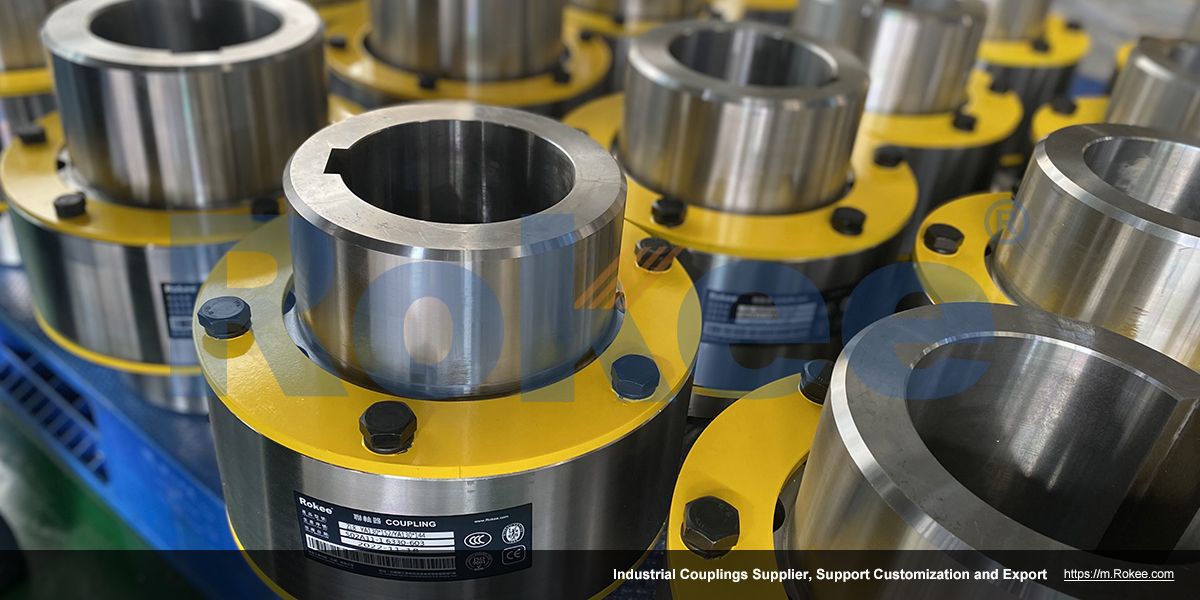
Pin Type Flexible Couplings
Rokee is a chinese Pin Type Flexible Couplings Manufacturer, provide Pin Type Flexible Couplings processing and customization services, Over the years, with excellent quality, we have been continuously providing many coupling products of various categories and uses complying with multiple standards and a full range of services, from the Pin Type Flexible Couplings selection to final installation and operation, for the industry fields of ferrous metallurgy, nuclear power, gas turbine, wind power, ropeway construction, lifting transportation, general equipment, etc. We strictly comply with quality system requirements and implement the whole process control to become a reliable and trustworthy partner of customers.
Providing customers with better Pin Type Flexible Couplings is always our driving force. Our aim is to transmit power for you and generate value for both of us. We look forward to joining you and becoming your partner for common progress.
-
![LZ Pin Type Flexible Couplings,LZ/ZL Elastic Pin Gear Coupling]()
LZ/ZL Elastic Pin Gear Coupling
LZ Pin Gear Coupling is the basic form of this series of couplings.View More -
![LZD Pin Type Flexible Couplings,LZD/ZLD Elastic Pin Gear Coupling With Conical Shaft Hole]()
LZD/ZLD Elastic Pin Gear Coupling With Conical Shaft Hole
One end of the LZD Pin Gear Coupling is designed with a conical shaft hole, and the clearance between the semi-couplings is increased to facilitate the fixing space at the shaft end.View More -
![LZZ Pin Type Flexible Couplings,LZZ/ZLL Elastic Pin Gear Coupling With Brake Wheel]()
LZZ/ZLL Elastic Pin Gear Coupling With Brake Wheel
LZZ Pin Gear Coupling is designed with a brake wheel, suitable for situations where braking is required.View More -
![LX Pin Type Flexible Couplings,LX/HL Flexible Pin Coupling]()
LX/HL Flexible Pin Coupling
LX(HL) Flexible Pin Coupling is the basic form of this series of couplings.View More -
![LXZ Pin Type Flexible Couplings,LXZ/HLL Flexible Pin Coupling With Brake Wheel]()
LXZ/HLL Flexible Pin Coupling With Brake Wheel
LXZ(HLL) Flexible Pin Coupling is designed with a brake wheel, suitable for situations where braking is required.View More -
![LT Pin Type Flexible Couplings,LT/TL Elastic Sleeve Pin Coupling]()
LT/TL Elastic Sleeve Pin Coupling
LT Elastic Sleeve Pin Coupling is the basic form of this series of couplings.View More -
![LTZ Pin Type Flexible Couplings,LTZ/TLL Elastic Sleeve Pin Coupling With Brake Wheel]()
LTZ/TLL Elastic Sleeve Pin Coupling With Brake Wheel
LTZ Elastic Sleeve Pin Coupling is designed with a brake wheel, suitable for situations where braking is required.View More
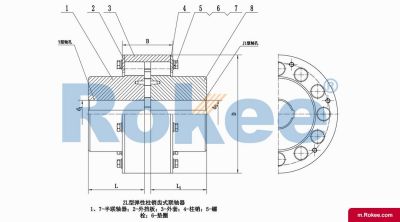
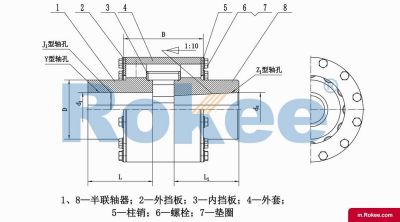
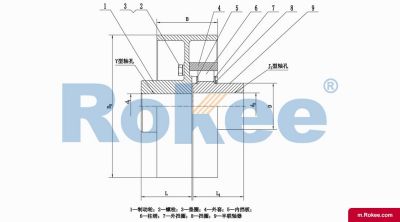
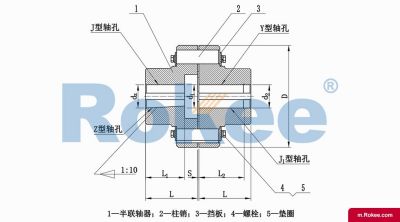
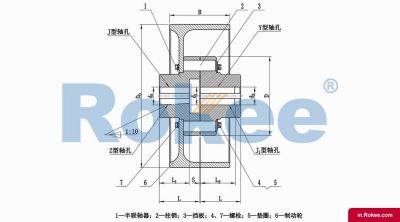
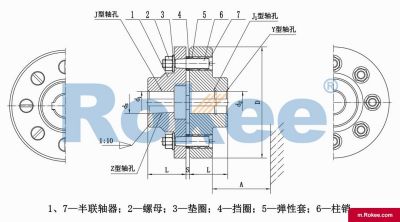
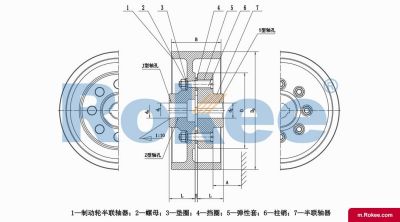
As a key component in mechanical transmission systems, the pin type flexible coupling solves the problem of alignment deviation in shaft connections through innovative structural design. This type of coupling utilizes a clever combination of pin shafts and elastic elements to ensure efficient torque transmission while providing excellent displacement compensation capability and vibration damping characteristics.
Pin type flexible coupling is a type of mechanical connection device that achieves power transmission through pin shafts and elastic elements. Its core design concept is to introduce controllable flexibility on the basis of rigid connection to solve the common problem of axis alignment in mechanical transmission systems. The typical structure of this type of coupling consists of three main parts: two half couplings installed on the driving shaft and the driven shaft respectively, a pin shaft assembly as a torque transmission medium, and elastic elements that provide flexibility and damping. Compared with traditional rigid couplings, pin type flexible couplings add deformable elements in their structure, allowing them to adapt to various complex working conditions without affecting power transmission.
The torque transmission mechanism is the core of the design of pin type flexible couplings. When the driving shaft rotates, the torque is first transmitted to the half coupling connected to it, and then the force is transmitted to the elastic element through the pin shaft, finally reaching the other half coupling and the driven shaft. In this process, the pin shaft not only undertakes the task of transmitting force, but also allows for limited relative motion inside the coupling through its special arrangement and structural design. Elastic components (usually made of polymer materials such as nylon, rubber, or polyurethane) undergo controllable elastic deformation when subjected to force. This deformation not only absorbs the impact energy in the transmission system, but also provides compensation space for the relative displacement between the two axes.
The displacement compensation capability of the pin type flexible coupling is manifested in three dimensions: axial displacement, radial displacement, and angular displacement. Axial displacement compensation refers to the ability of a coupling to adapt to the relative movement of two shafts in the axial direction, which may be caused by thermal expansion or mechanical installation errors. Radial displacement compensation allows for a certain degree of parallel offset between the two axis centerlines, while angular displacement compensation enables the coupling to adapt to the angular deviation between the two axes. Modern high-performance pin type flexible couplings can simultaneously compensate for combinations of these three displacements, with compensation amounts ranging from axial ± 0.5-5mm, radial 0.2-3mm, and angular 0.5 ° -3 ° depending on the type, greatly reducing the precision requirements for mechanical installation.
In terms of vibration control, the pin type flexible coupling performs well. The damping characteristics of elastic components can effectively absorb and isolate torsional and lateral vibrations in transmission systems. When the system is subjected to sudden impact loads, the elastic element extends the duration of force through instantaneous deformation, reducing the impact of peak loads on transmission components. Test data shows that high-quality pin type flexible couplings can reduce system vibration amplitude by 20-30%, especially with significant filtering effect on high-frequency vibration. This characteristic gives the pin type flexible coupling an irreplaceable advantage in precision transmission systems and long axis connections.
The dynamic response characteristics of the pin type flexible coupling depend on the stiffness and damping coefficient of the elastic element. Engineers can optimize the dynamic performance of couplings by adjusting parameters such as the hardness of elastic materials, the arrangement density of pin shafts, and pre tightening force. Softer elastic components provide better vibration isolation, but may affect transmission accuracy; A harder elastic element can ensure higher torsional stiffness, making it suitable for situations that require precise position control. Some high-end designs use elastic materials with nonlinear stiffness characteristics, which enable the coupling to exhibit different dynamic characteristics under different loads, thus adapting to more complex working conditions.
Environmental adaptability is another important feature of modern flexible couplings. By selecting special elastic materials such as oil resistant rubber, high-temperature resistant polyurethane, or corrosion-resistant nylon, the pin type flexible coupling can work stably in the temperature range of -40 ℃ to 120 ℃, and some special designs can even adapt to extreme environments of -60 ℃ to 150 ℃. In corrosive environments such as chemical and marine environments, couplings protected by stainless steel pin shafts and special coatings can maintain stable performance for a long time, significantly extending maintenance cycles and service life.
Pin type flexible couplings can be divided into various variants with different performance characteristics based on their specific structural forms and types of elastic components, each with its unique advantages and application scenarios. A deep understanding of the structural characteristics and performance differences of these different types is crucial for selecting and optimizing applications correctly. Below, we will provide a detailed introduction to several main types of pin type flexible couplings and their technical characteristics.
The elastic pin toothed coupling is one of the most common pin type flexible couplings in industrial applications. Its typical structure consists of two half couplings with semi-circular grooves, an outer ring, and a nylon pin. This type of coupling uses nylon column pins instead of traditional rubber sleeve structures. One end of the column pin is usually made into a drum shape to increase compensation, and fixed retaining rings are installed at both ends to prevent slippage. The elastic pin tooth coupling has significant advantages such as high torque transmission, simple structure, good processability, and lubrication free maintenance. Under the same torque conditions, its rotational diameter is about 15-20% smaller than traditional gear couplings, with a small volume and light weight, which can partially replace gear couplings. Nylon column pins, as self-lubricating materials, not only save lubricating oil but also purify the working environment, making them particularly suitable for industries with high cleanliness requirements such as food and medicine. However, this type of coupling also has its limitations. The damping coefficient of nylon material is lower, and its vibration reduction performance is not as good as that of rubber component couplings. Moreover, the temperature resistance range of nylon is generally -20 ℃~70 ℃, and its temperature sensitivity limits its application in extreme environments. The improved elastic column pin toothed coupling increases the contact area through the design of locking blocks and spring washers, improving stability under high-speed rotation conditions and enabling it to adapt to higher demand industrial scenarios.
Elastic sleeve column pin coupling is another widely used pin type flexible coupling, characterized by the use of column pins with rubber or polyurethane elastic sleeves to connect the two halves of the coupling. Compared with the elastic pin tooth coupling, this design provides greater compensation capability and better vibration reduction effect through the deformation of the elastic sleeve. The material and hardness of the elastic sleeve can be adjusted according to application requirements. A softer elastic sleeve provides better vibration isolation but has lower torque transmission ability, while a harder elastic sleeve is suitable for high torque transmission but has relatively smaller compensation ability. A significant advantage of the elastic sleeve column pin coupling is that the elastic components are easy to replace. When the elastic sleeve wears out, simply remove the baffle to replace it, without moving the entire coupling or related equipment, greatly reducing maintenance time and costs. This type of coupling is suitable for medium power transmission, situations with certain impact and vibration, such as rotating equipment such as pumps, fans, compressors, etc. However, in extreme temperature environments or in the presence of highly corrosive media, the aging problem of rubber elastic sleeves needs special consideration.
The rigid pin type elastic coupling represents the high-end design of pin type flexible couplings, which use a combination of metal components and high-quality synthetic rubber elastic elements, combining high strength and good elastic compensation capability. Its compact design and lightweight characteristics make it particularly suitable for high-speed applications, while its low inertia torque is particularly advantageous for precision transmissions such as servo systems. The elastic element of the rigid pin type elastic coupling is usually made of high-quality synthetic rubber reinforced with two layers of fibers. The standard type is conductive material to prevent static electricity accumulation, and insulation type options can also be provided to meet special electrical requirements. The torque transmission range of this type of coupling is extremely wide, ranging from 210Nm to 1400000Nm, including 26 specifications and 8 structural types. It is suitable for environmental temperatures ranging from -30 ° C to 80 ° C and performs outstandingly in high-speed operations and high torque transmission scenarios. They are widely used in pump drive systems, engine drive systems, and the connection between gearboxes and drive equipment, especially suitable for heavy industry applications that require both high torque transmission and certain deviation compensation capabilities.
Safety pin type coupling is a special category of pin type flexible coupling designed specifically for system overload protection. This type of coupling connects the input shaft and output shaft through a precisely calculated safety pin. When the system encounters overload or abnormal impact, the safety pin will break at a preset torque threshold, thereby cutting off the power transmission path and protecting core equipment such as motors and gearboxes from damage.
Pin type flexible couplings play an important role in the field of mechanical transmission, mainly due to their outstanding performance characteristics and significant technological advantages. These characteristics enable it to demonstrate comprehensive value beyond other types of couplings in various industrial applications, playing a critical role in everything from precision instruments to heavy machinery.
« Pin Type Flexible Couplings » Post Date: 2024/5/9
URL: https://m.rokee.com/tags/pin-type-flexible-couplings.html