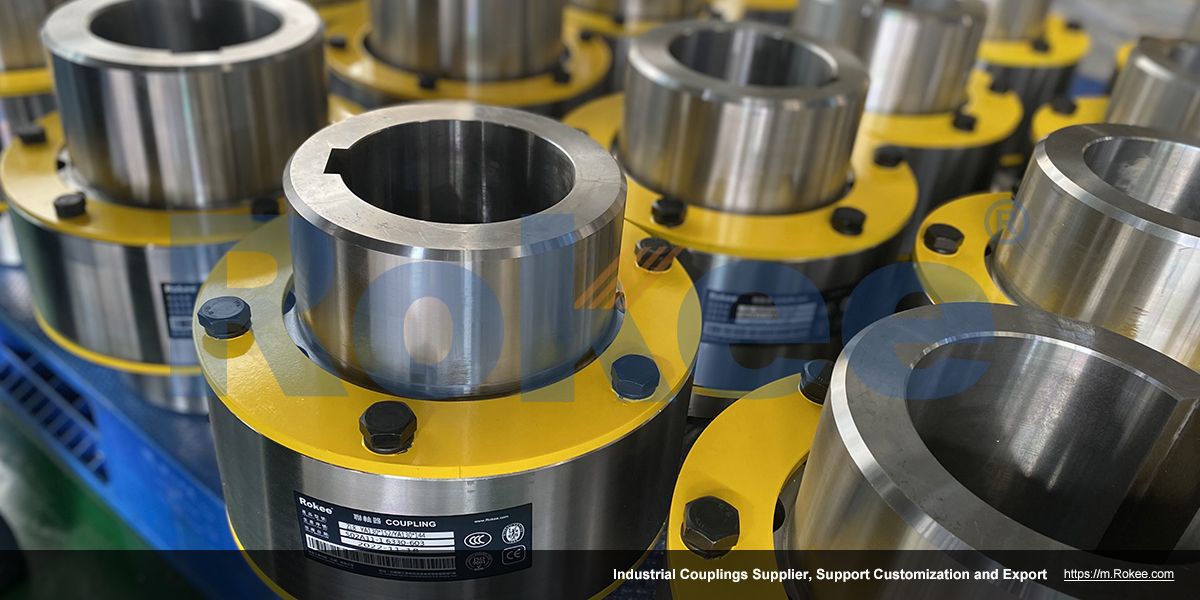
Pin Bush Type Flexible Couplings
Rokee is a chinese Pin Bush Type Flexible Couplings Manufacturer, provide Pin Bush Type Flexible Couplings processing and customization services, Over the years, with excellent quality, we have been continuously providing many coupling products of various categories and uses complying with multiple standards and a full range of services, from the Pin Bush Type Flexible Couplings selection to final installation and operation, for the industry fields of ferrous metallurgy, nuclear power, gas turbine, wind power, ropeway construction, lifting transportation, general equipment, etc. We strictly comply with quality system requirements and implement the whole process control to become a reliable and trustworthy partner of customers.
Providing customers with better Pin Bush Type Flexible Couplings is always our driving force. Our aim is to transmit power for you and generate value for both of us. We look forward to joining you and becoming your partner for common progress.
-
![LZ Pin Bush Type Flexible Couplings,LZ/ZL Elastic Pin Gear Coupling]()
LZ/ZL Elastic Pin Gear Coupling
LZ Pin Gear Coupling is the basic form of this series of couplings.View More -
![LZD Pin Bush Type Flexible Couplings,LZD/ZLD Elastic Pin Gear Coupling With Conical Shaft Hole]()
LZD/ZLD Elastic Pin Gear Coupling With Conical Shaft Hole
One end of the LZD Pin Gear Coupling is designed with a conical shaft hole, and the clearance between the semi-couplings is increased to facilitate the fixing space at the shaft end.View More -
![LZZ Pin Bush Type Flexible Couplings,LZZ/ZLL Elastic Pin Gear Coupling With Brake Wheel]()
LZZ/ZLL Elastic Pin Gear Coupling With Brake Wheel
LZZ Pin Gear Coupling is designed with a brake wheel, suitable for situations where braking is required.View More -
![LX Pin Bush Type Flexible Couplings,LX/HL Flexible Pin Coupling]()
LX/HL Flexible Pin Coupling
LX(HL) Flexible Pin Coupling is the basic form of this series of couplings.View More -
![LXZ Pin Bush Type Flexible Couplings,LXZ/HLL Flexible Pin Coupling With Brake Wheel]()
LXZ/HLL Flexible Pin Coupling With Brake Wheel
LXZ(HLL) Flexible Pin Coupling is designed with a brake wheel, suitable for situations where braking is required.View More -
![LT Pin Bush Type Flexible Couplings,LT/TL Elastic Sleeve Pin Coupling]()
LT/TL Elastic Sleeve Pin Coupling
LT Elastic Sleeve Pin Coupling is the basic form of this series of couplings.View More -
![LTZ Pin Bush Type Flexible Couplings,LTZ/TLL Elastic Sleeve Pin Coupling With Brake Wheel]()
LTZ/TLL Elastic Sleeve Pin Coupling With Brake Wheel
LTZ Elastic Sleeve Pin Coupling is designed with a brake wheel, suitable for situations where braking is required.View More
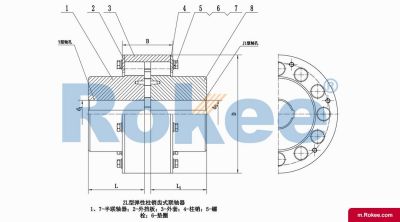
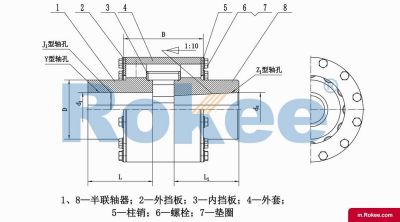
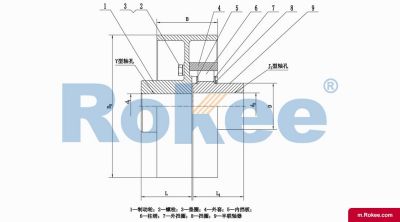
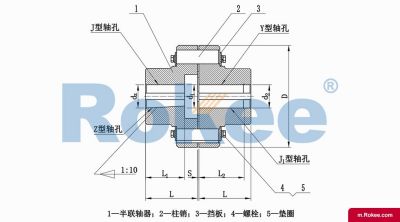
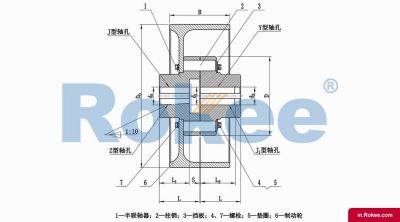
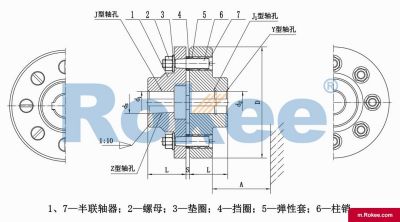
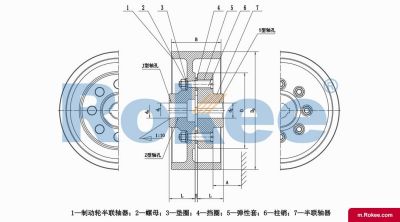
As a key component in mechanical transmission systems, the pin bush type flexible coupling achieves a perfect combination of efficient torque transmission and deviation compensation through innovative combination design of elastic sleeve and pin shaft. This type of coupling exhibits unique advantages in industrial scenarios that require moderate flexible connections and precise transmission.
The pin bush type flexible coupling is a mechanical transmission device that adopts a combination structure of elastic sleeve and precision pin shaft, and belongs to an important branch of flexible couplings with elastic elements. The core design concept is to compensate for the relative displacement between the two shafts through the deformation ability of the elastic lining, while ensuring the accuracy of torque transmission through the rigid transmission of the pin shaft. This type of coupling occupies a unique position in the field of industrial transmission, especially suitable for applications that require both certain flexibility compensation and transmission accuracy.
Compared with traditional couplings, the pin sleeve design has multiple unique advantages. In terms of compensation capability, it can simultaneously handle axial, radial, and angular deviations, with typical parameters of axial ± 2mm, radial ± 1mm, and angular ± 1 °; In terms of transmission performance, its torque transmission efficiency is over 99%, and the no backlash design ensures motion accuracy; In terms of maintenance convenience, worn bushings can be replaced separately without disassembling the entire coupling, significantly reducing maintenance costs. These characteristics have gradually replaced traditional gear couplings and rigid couplings in many industrial fields.
The working principle of the bushing type flexible coupling is based on the combination of elastic mechanics and contact mechanics. When the driving shaft rotates, torque is transmitted to the driven shaft through the pin bushing interface, and the elastic bushing undergoes controllable deformation to absorb shaft deviation. This design not only avoids the sensitivity problem of pure rigid connections, but also overcomes the deficiency of insufficient torsional stiffness of fully elastic couplings, achieving an ideal transmission state of "combining rigidity and flexibility".
The ingenuity of the bushing type flexible coupling lies in its unique structural design, with each component carefully calculated and optimized. A typical pin sleeve coupling consists of core components such as a hub, pin shaft, elastic sleeve, fastening system, and protective cover, which work together to achieve efficient and reliable power transmission.
Wheel hub design is the foundation of couplings, usually made of high-strength cast iron or alloy steel. The wheel hub structure is divided into two forms: single flange and double flange. The single flange design is compact and lightweight, suitable for space limited occasions; The double flange structure has strong rigidity and is more suitable for heavy-duty applications. The connection methods between the wheel hub and the shaft are diverse, including modern technologies such as keyway connection, expansion sleeve connection, and hydraulic locking. It is particularly noteworthy that modern wheel hubs often adopt finite element optimization design, which removes excess materials through topology optimization technology, achieving lightweight while ensuring strength. This design can reduce the weight of the coupling by 15-20% and the moment of inertia by more than 10%.
As the core path of torque transmission, the design of the shaft system is particularly critical. The pin shaft is usually made of high-strength alloy steel (such as 40CrNiMoA) that has undergone quenching and tempering heat treatment (HRC28-32) and precision grinding processing. The surface roughness is controlled within Ra0.8 to ensure a good fit with the liner. The diameter of the pin shaft is determined by calculating the transmitted torque, with common specifications ranging from 10mm to 50mm. There are two types of arrangement: single row and double row. The double row staggered arrangement design can increase torque transmission capacity by 30-40% while reducing the load on a single pin shaft. The fixing method of the pin shaft is also specially designed, generally using a conical locking structure or high-strength bolt pre tightening to ensure that it will not loosen under high dynamic loads.
The elastic sleeve is the soul component of the pin sleeve coupling, and its material selection and structural design directly determine the performance of the coupling. There are three main types of modern lining materials: polyurethane elastomers, synthetic rubber, and composite materials. Polyurethane lining has excellent wear resistance and tear resistance, suitable for high-frequency cycling conditions; Rubber lining has good damping characteristics and significant vibration reduction effect; Composite lining combines the strength of metal and the elasticity of rubber, making it suitable for extreme working conditions. The geometric shape of the liner has also been carefully designed, with common types including cylindrical, drum shaped, and irregular structures. The drum shaped design provides greater angular compensation capability (up to ± 1.5 °), while the irregular liner can achieve multi-directional composite compensation.
The bushing type flexible coupling exhibits excellent comprehensive performance in industrial applications, and its unique design concept surpasses traditional coupling solutions in multiple aspects. These advantages are not only reflected in the basic transmission functions, but also in the adaptability to complex working conditions and the economic viability of long-term use.
The outstanding deviation compensation capability is the most prominent feature of the pin sleeve coupling. Compared with rigid couplings, it can compensate for axial, radial, and angular deviations simultaneously, with typical parameters of axial ± 2.5mm, radial ± 1.2mm, and angular ± 1.5 °. This multi-directional compensation capability makes it particularly suitable for situations where there is foundation settlement, thermal deformation, or installation error. It is worth noting that the unique feature of the pin bushing structure is that there will be no sliding friction during the compensation process, so there will be no performance degradation caused by wear.
The vibration control characteristics make this type of coupling perform excellently in dynamic working conditions. The high damping characteristics of elastic bushings can effectively absorb torsional and radial vibrations, with a vibration attenuation rate of up to 60-70%. For common 1-3 order vibration frequencies, the damping effect of the pin lining structure is particularly significant. In typical applications such as motor pump units, the use of pin sleeve couplings can reduce system vibration values by more than 50% and noise by 8-10 dB (A). This damping characteristic not only improves the smoothness of equipment operation, but also extends the service life of related components such as bearings and seals.
Accurate transmission performance is another major advantage of the pin bushing structure. The torsional stiffness curve of the coupling has been carefully designed to maintain linear characteristics within the normal operating range, ensuring precise torque transmission. Compared with pure elastic couplings, its torsional stiffness is increased by 3-5 times and its dynamic response characteristics are better. At the same time, the optimized preload design eliminates transmission clearance, achieving seamless motion transmission without backlash, and the position control accuracy can reach ± 0.1 °, meeting the requirements of precision transmission. This precision makes it outstanding in high-precision equipment such as CNC machine tools and robots.
« Pin Bush Type Flexible Couplings » Post Date: 2024/5/9
URL: https://m.rokee.com/tags/pin-bush-type-flexible-couplings.html