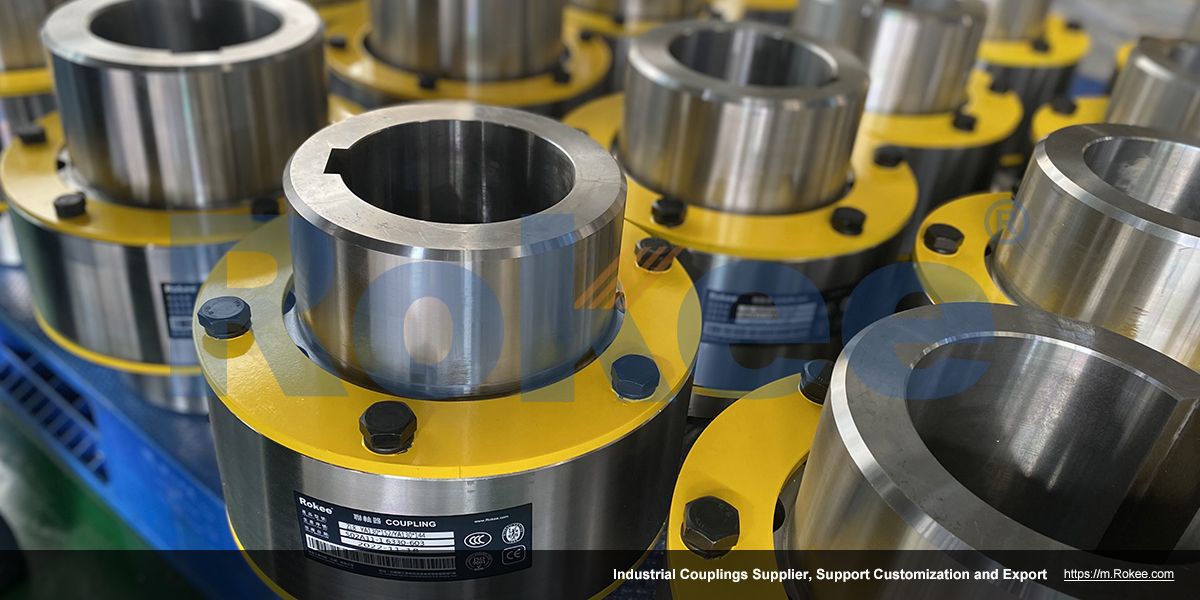
Bushed Pin Type Flexible Couplings
Rokee is a chinese Bushed Pin Type Flexible Couplings Manufacturer, provide Bushed Pin Type Flexible Couplings processing and customization services, Over the years, with excellent quality, we have been continuously providing many coupling products of various categories and uses complying with multiple standards and a full range of services, from the Bushed Pin Type Flexible Couplings selection to final installation and operation, for the industry fields of ferrous metallurgy, nuclear power, gas turbine, wind power, ropeway construction, lifting transportation, general equipment, etc. We strictly comply with quality system requirements and implement the whole process control to become a reliable and trustworthy partner of customers.
Providing customers with better Bushed Pin Type Flexible Couplings is always our driving force. Our aim is to transmit power for you and generate value for both of us. We look forward to joining you and becoming your partner for common progress.
-
![LT Bushed Pin Type Flexible Couplings,LT/TL Elastic Sleeve Pin Coupling]()
LT/TL Elastic Sleeve Pin Coupling
LT Elastic Sleeve Pin Coupling is the basic form of this series of couplings.View More -
![LTZ Bushed Pin Type Flexible Couplings,LTZ/TLL Elastic Sleeve Pin Coupling With Brake Wheel]()
LTZ/TLL Elastic Sleeve Pin Coupling With Brake Wheel
LTZ Elastic Sleeve Pin Coupling is designed with a brake wheel, suitable for situations where braking is required.View More
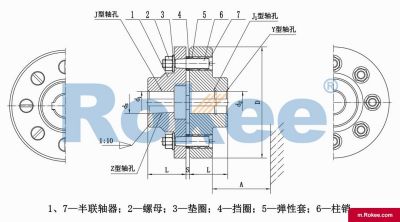
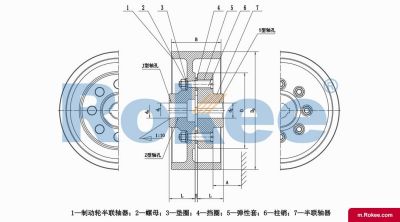
The bushed pin type flexible coupling is composed of cast iron or cast steel couplings with the same half structure, connected by column pins with rubber elastic sleeves. Its unique design lies in:
Elastic buffering mechanism: The rubber sleeve outside the column pin can absorb vibration energy and compensate for radial/angular offset (radial 0.2-0.6mm, angular 0.5 ° -1.5 °) due to compression deformation
Power transmission principle: Torque is transmitted through the frictional force of the pin group, and the deformation of the rubber sleeve determines the compensation ability. The maximum transmitted torque can reach 20000N · m
Maintenance free design: using self-lubricating nylon column pins, no additional lubrication required, working temperature range -20 ℃~80 ℃
The bushed pin type flexible coupling achieves buffering through the deformation of the rubber sleeve, while the elastic column pin coupling directly relies on the shear deformation of the nylon column pin, which has stronger compensation ability but weaker vibration reduction effect.
In the realm of mechanical power transmission, flexible couplings stand as indispensable components that bridge rotating shafts, mitigate operational stresses, and ensure seamless power delivery across diverse industrial machinery. Among the broad spectrum of flexible coupling designs, the bushed pin type flexible coupling emerges as a widely adopted solution, prized for its balanced blend of simplicity, durability, and functional versatility. Unlike rigid couplings that demand perfect shaft alignment and offer no tolerance for misalignment or vibration, this coupling variant integrates flexible elements to address common mechanical challenges, making it a staple in countless low-to-medium speed and torque transmission systems. Delving into its intrinsic structure, core performance attributes, distinct classifications, and real-world applications reveals why it remains a preferred choice for engineers and technicians seeking reliable, low-maintenance power transmission solutions.
At its core, the bushed pin type flexible coupling features a straightforward yet robust structural configuration, engineered to transmit torque efficiently while accommodating minor shaft misalignments and dampening vibrational forces. The fundamental assembly consists of two key metallic components—typically referred to as half-couplings or flange hubs—and a set of precision-machined pins paired with resilient elastic bushings. Each half-coupling is crafted from high-strength ferrous metal, chosen for its exceptional mechanical strength, wear resistance, and ability to withstand repeated torsional loads; common materials include forged steel and cast iron, selected based on the intended operational load and environmental conditions. These half-couplings are mounted securely onto the driving and driven shafts respectively, often secured via keyways and locking fasteners to prevent slippage and ensure a firm, non-slip connection that maintains torque transfer integrity.
The defining structural feature of this coupling lies in the pin-and-bushing assembly that links the two half-couplings. The pins, machined to tight tolerances for a precise fit, pass through aligned bores in the flanges of both half-couplings, acting as the primary torque-transmitting elements. Encasing each pin is a flexible bushing, typically fabricated from elastomeric materials such as natural rubber, synthetic rubber, or polyurethane, chosen for their exceptional elasticity, shock-absorbing properties, and resistance to fatigue. These bushings fill the clearance between the pin and the bore walls, creating a cushioned interface that eliminates metal-to-metal contact during operation. This design eliminates the need for complex lubrication systems, a stark contrast to gear couplings or other high-maintenance flexible couplings, as the elastic bushings self-lubricate to a degree and reduce friction naturally. The overall structure is compact, with a low axial footprint, simplifying installation and removal even in confined mechanical spaces; disassembly primarily involves removing the pins and replacing worn bushings, streamlining routine maintenance tasks without requiring specialized tools or extensive downtime.
Beyond its structural simplicity, the bushed pin type flexible coupling delivers a suite of performance characteristics that make it highly adaptable to varied operational scenarios. Foremost among these is its ability to compensate for multiple forms of shaft misalignment, a critical advantage in real-world machinery where perfect alignment is rarely achievable due to manufacturing tolerances, thermal expansion, or mechanical settling during operation. It effectively accommodates small angular misalignments, radial offsets, and limited axial endplay between the driving and driven shafts, preventing the transfer of excessive bending and shear stresses to connected equipment such as motors, gearboxes, pumps, and compressors. By absorbing these misalignment-induced stresses, the coupling safeguards critical components from premature wear, fatigue cracking, and catastrophic failure, significantly extending the service life of the entire power transmission system.
Another standout performance trait is its superior vibration damping and shock absorption capability. The elastomeric bushings act as a natural shock absorber, dissipating transient impact loads and reducing torsional vibrations that commonly occur during startup, shutdown, or sudden load fluctuations. This damping effect not only smoothens power delivery but also minimizes noise generation, creating a quieter operational environment and reducing wear on adjacent mechanical parts. The coupling exhibits reliable torsional stiffness, ensuring efficient torque transmission without excessive windup or power loss under normal operating loads, while still offering the flexibility to handle minor overloads without permanent deformation. It operates effectively across a moderate range of rotational speeds and torque outputs, making it unsuitable for ultra-high-speed or heavy-duty extreme-load applications but ideal for the vast majority of general industrial power transmission setups. Additionally, the elastic bushings provide a degree of electrical insulation between the two shafts, preventing the transfer of stray electrical currents that could damage sensitive bearings or electronic components in connected machinery.
While adhering to the core pin-and-bushing design, bushed pin type flexible couplings are available in several distinct varieties, each tailored to address specific operational requirements, spatial constraints, or functional needs. The most common classification is based on structural modifications and auxiliary features, with each variant retaining the core working principle but offering unique advantages for specialized use cases. The standard flange type bushed pin coupling represents the baseline design, featuring solid flanges on both half-couplings and a direct pin-and-bushing connection; this variant is the most widely used, offering a balance of performance and cost-effectiveness for general-purpose applications where no special spatial or functional accommodations are needed. It is easy to manufacture, install, and maintain, making it the go-to choice for standard industrial machinery setups.
A second prominent variety is the spacer type bushed pin flexible coupling, which incorporates a rigid spacer element between the two half-couplings. This spacer creates a controlled gap between the driving and driven shafts, addressing applications where a greater axial distance between shafts is required, or where routine inspection and maintenance of adjacent components (such as bearings or seals) necessitate additional clearance. The spacer maintains the coupling’s flexibility and torque-transmitting ability while enhancing accessibility, making it suitable for machinery layouts where direct access to shaft-mounted components is restricted. Despite the added spacer, the design retains the simple pin-and-bushing assembly, ensuring maintenance remains straightforward and does not compromise operational reliability.
A third specialized variant is the brake wheel integrated bushed pin coupling, which features a built-in brake wheel or brake drum on one of the half-couplings. This design eliminates the need for a separate brake mounting assembly, streamlining the mechanical layout for equipment that requires integrated braking functionality, such as material handling machinery, conveyors, and lifting systems. The brake wheel is machined to precise tolerances to ensure optimal friction and braking performance, while the core pin-and-bushing assembly continues to deliver reliable power transmission and misalignment compensation. This variant combines two critical functions into a single compact component, reducing overall component count, simplifying installation, and optimizing space utilization in machinery where footprint is limited.
Additional variations include those with modified bushing designs, such as tapered bushings or reinforced elastomeric bushings, engineered to handle slightly higher loads or more severe misalignment conditions than standard models. Some variants also feature corrosion-resistant coatings on metallic components to enhance durability in harsh operating environments, such as humid, chemically exposed, or outdoor settings. Regardless of the specific variety, all bushed pin type flexible couplings maintain the core design principles of simplicity, flexibility, and low maintenance, ensuring consistent performance across their respective application niches.
The combination of robust structure, reliable performance, and diverse varieties positions the bushed pin type flexible coupling for extensive use across nearly every major industrial sector, wherever moderate-speed, moderate-torque power transmission is required. One of the most prevalent applications is in fluid handling machinery, including centrifugal pumps, water pumps, oil pumps, and compressors. These devices often experience minor shaft misalignment due to pipeline pressure, thermal expansion, or base movement, and the coupling’s misalignment compensation and vibration damping properties ensure smooth, leak-free operation while protecting pump internals from damage. In agricultural machinery, the coupling is widely used in tractors, harvesters, irrigation systems, and grain processing equipment, where it withstands dusty, outdoor conditions and delivers consistent power transmission between engines and working components, withstanding the intermittent loads and shocks common in agricultural operations.
In the manufacturing and material handling sector, bushed pin type flexible couplings are integral to conveyor systems, elevators, mixers, crushers, and small to medium-sized gear drives. Conveyor systems, in particular, benefit from the coupling’s shock absorption, as frequent start-stop cycles and uneven material loads create transient stresses that the coupling effectively dissipates, reducing downtime and maintenance costs. The brake wheel-integrated variants are especially valuable here, providing reliable braking for inclined conveyors and lifting equipment to ensure safe and controlled operation. In light to medium industrial machinery, such as small electric motors, fans, blowers, and machine tools, the coupling’s compact design and low maintenance requirements make it an ideal choice, minimizing installation complexity and long-term upkeep.
The coupling also finds widespread use in marine and offshore auxiliary machinery, power generation equipment (such as small diesel generators and alternators), textile machinery, printing presses, and food processing equipment. In marine applications, corrosion-resistant variants withstand the harsh, humid marine environment, while in food processing, designs with smooth, easy-to-clean surfaces meet stringent hygiene standards without compromising performance. Its versatility extends to construction machinery, including small concrete mixers, vibrators, and portable power tools, where durability and resistance to rough handling are paramount. Across all these applications, the coupling’s ability to reduce maintenance demands is a key advantage; worn elastomeric bushings can be quickly replaced without removing the entire coupling from the shafts, minimizing operational downtime and reducing total cost of ownership over the equipment’s lifespan.
It is important to note that while the bushed pin type flexible coupling excels in moderate operational conditions, it is not designed for extreme environments involving ultra-high rotational speeds, excessive torsional loads, or extreme temperatures beyond the thermal limits of the elastomeric bushings. In such scenarios, specialized flexible couplings such as gear couplings, diaphragm couplings, or grid couplings are more suitable. However, for the vast majority of general industrial applications that fall within moderate speed and torque ranges, the bushed pin type flexible coupling stands out as a cost-effective, reliable, and practical solution. Its enduring popularity stems from its harmonious balance of structural simplicity, functional flexibility, and operational resilience, addressing the core needs of power transmission systems while minimizing complexity and maintenance burdens.
In summary, the bushed pin type flexible coupling represents a masterclass in practical mechanical design, merging basic engineering principles with real-world operational needs. Its well-conceived structural layout, centered on metallic half-couplings, precision pins, and resilient elastomeric bushings, delivers essential misalignment compensation, vibration damping, and efficient torque transmission. The diverse range of varieties—from standard flange models to spacer and brake wheel-integrated variants—ensures adaptability to specialized operational demands, while its broad industrial applicability spans fluid handling, agriculture, material handling, manufacturing, and beyond. As a cornerstone of modern mechanical power transmission, this coupling continues to play a vital role in keeping industrial machinery running smoothly, efficiently, and reliably, proving that even the simplest designs can deliver exceptional long-term value when engineered with precision and purpose.
« Bushed Pin Type Flexible Couplings » Update Date: 2026/3/6
URL: https://m.rokee.com/tags/bushed-pin-type-flexible-couplings.html