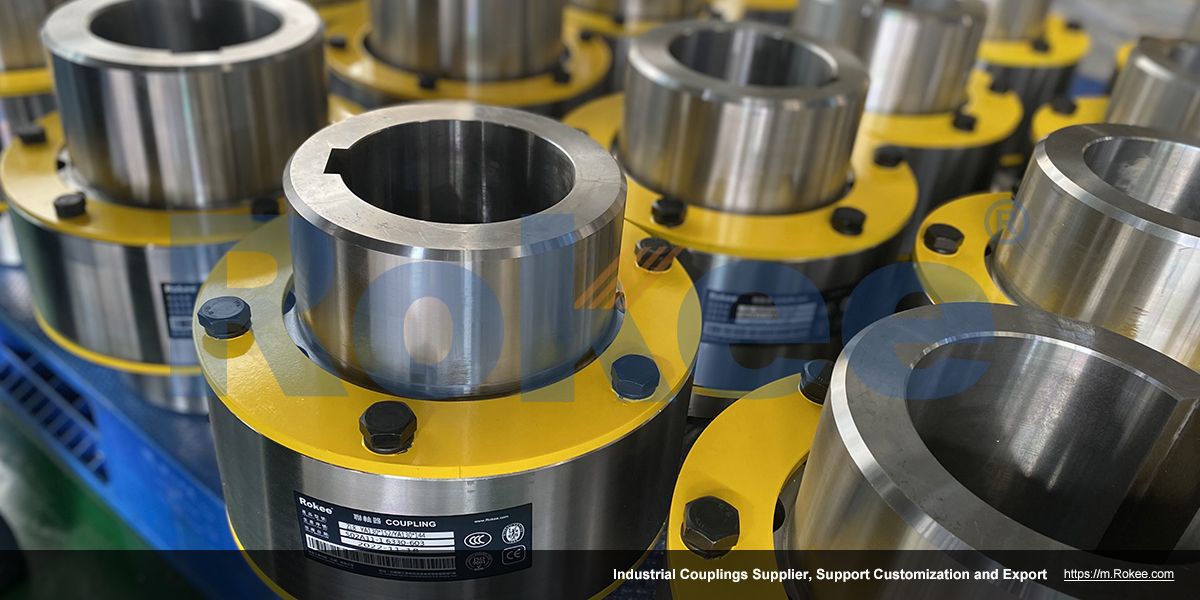
Bushed Pin Couplings
Rokee is a chinese Bushed Pin Couplings Manufacturer, provide Bushed Pin Couplings processing and customization services, Over the years, with excellent quality, we have been continuously providing many coupling products of various categories and uses complying with multiple standards and a full range of services, from the Bushed Pin Couplings selection to final installation and operation, for the industry fields of ferrous metallurgy, nuclear power, gas turbine, wind power, ropeway construction, lifting transportation, general equipment, etc. We strictly comply with quality system requirements and implement the whole process control to become a reliable and trustworthy partner of customers.
Providing customers with better Bushed Pin Couplings is always our driving force. Our aim is to transmit power for you and generate value for both of us. We look forward to joining you and becoming your partner for common progress.
-
![LT Bushed Pin Couplings,LT/TL Elastic Sleeve Pin Coupling]()
LT/TL Elastic Sleeve Pin Coupling
LT Elastic Sleeve Pin Coupling is the basic form of this series of couplings.View More -
![LTZ Bushed Pin Couplings,LTZ/TLL Elastic Sleeve Pin Coupling With Brake Wheel]()
LTZ/TLL Elastic Sleeve Pin Coupling With Brake Wheel
LTZ Elastic Sleeve Pin Coupling is designed with a brake wheel, suitable for situations where braking is required.View More
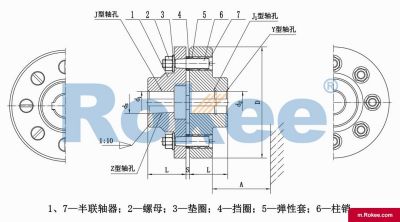
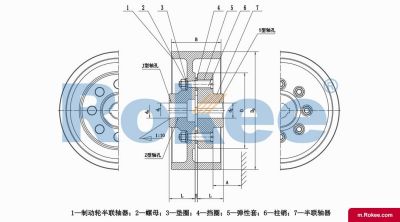
Structural composition
Flange type half coupling: Two symmetrical flanges with bolt holes, usually made of cast iron or steel material, with a surface precision machined to ensure the flatness of the contact surface.
Rubber lining: an elastic element nested in bolt holes, mostly made of oil resistant chloroprene rubber or polyurethane, with a hardness range of 60-80 Shore A, providing radial compression deformation space.
Column pin component: High strength alloy steel pin, chrome plated anti rust surface, connected to the two halves of the coupling through the bushing, allowing for slight sliding while transmitting torque.
Compensation mechanism
Axial displacement: The rubber liner can absorb an axial displacement of ± 1.5mm (such as thermal expansion difference) when subjected to compression deformation.
Radial offset: The lateral deformation of the liner adapts to radial deviations of ≤ 0.8mm (such as installation errors).
Angular deviation: Angle compensation within ± 1 ° is achieved through uneven compression of the lining (such as misalignment of the shaft system).
Torque transmission path
Drive shaft → flange half coupling → column pin squeezing rubber sleeve → driven side flange → driven shaft, vibration energy is converted into thermal energy dissipation by internal friction of rubber molecules.
Typical applications
Motor pump assembly: compensates for instantaneous alignment deviation during motor start-up to avoid bearing overload.
Conveyor Drive: Absorbs shaft displacement caused by chain tension and protects gearbox gears.
Ventilation system: isolate the vibration transmission caused by the unbalanced movement of the fan impeller.
In the realm of mechanical power transmission, couplings serve as indispensable components that bridge rotating shafts, enabling the transfer of torque while accommodating operational discrepancies and safeguarding adjacent machinery. Among the diverse array of coupling designs, the bushed pin coupling stands out as a versatile, reliable, and widely adopted solution, prized for its balanced blend of structural simplicity, functional flexibility, and durable performance. Unlike rigid couplings that demand perfect shaft alignment and offer no tolerance for misalignment or vibration, bushed pin couplings fall into the category of flexible couplings, engineered to address the inherent challenges of real-world mechanical systems, where shaft misalignment, torsional shock, and operational vibration are commonplace.
At its core, the bushed pin coupling features a straightforward yet robust structural configuration, consisting of a limited number of precision-engineered components that work in tandem to deliver consistent power transmission. The fundamental framework comprises two flanged hubs, a set of hardened steel pins, and elastic or rigid bushings that encase the pins, along with fastening elements to secure the assembly. The two flanged hubs are the primary mounting components, designed to be firmly affixed to the driving and driven shafts respectively, typically via keyways, interference fits, or clamping mechanisms that ensure a tight, slip-free connection and prevent rotational loss during torque transfer. Each hub is equipped with evenly spaced, precision-drilled holes around its flange periphery, sized to accommodate the pins and bushings with controlled clearances that facilitate flexibility without compromising structural integrity. The hardened steel pins, crafted from high-strength alloy steel to resist bending, shear, and wear, pass through the aligned holes in both flanged hubs, acting as the primary torque-transmitting elements that link the two hubs and transfer rotational force from the driving shaft to the driven shaft.
The most distinctive structural element of the bushed pin coupling is the bushing, which encases each pin and fits within the hub holes, serving as the critical interface between the rigid pins and the metallic hubs. Bushings are available in two primary material categories—elastic polymeric materials and rigid metallic materials—each tailored to modify the coupling’s performance characteristics to suit specific operational demands. Elastic bushings, commonly fabricated from rubber, polyurethane, nylon, or other engineered polymers, introduce flexibility and damping into the coupling system, absorbing shock loads, reducing torsional vibration, and compensating for various forms of shaft misalignment. Rigid metallic bushings, often made from bronze, cast iron, or hardened steel, enhance the coupling’s torque-carrying capacity and radial stiffness, making it suitable for heavy-duty, high-torque applications where minimal deflection is required. The modular design of the bushed pin coupling allows for effortless replacement of worn bushings without disassembling the entire hub assembly, streamlining maintenance routines and minimizing downtime in industrial operations. This simplicity of structure not only reduces manufacturing complexity and costs but also ensures ease of installation, alignment, and repair, even in remote or harsh working environments where access to specialized tools is limited.
The performance of a bushed pin coupling is defined by a unique set of attributes that make it adaptable to a broad spectrum of operating conditions, setting it apart from other flexible coupling variants such as gear couplings, jaw couplings, or disc couplings. One of its most prominent performance advantages is its ability to compensate for multiple types of shaft misalignment, a critical capability in industrial settings where perfect shaft alignment is rarely achievable due to manufacturing tolerances, thermal expansion, mechanical settling, or operational wear. Bushed pin couplings can effectively accommodate angular misalignment, where the axes of the driving and driven shafts intersect at a slight angle; parallel misalignment, where the shaft axes remain parallel but are offset radially; and axial misalignment, where the shafts shift longitudinally relative to one another. The degree of misalignment tolerance varies based on bushing material and coupling size, with elastic-bushed models offering greater misalignment accommodation compared to rigid-bushed variants, ensuring smooth power transmission even when alignment deviations occur during operation.
Beyond misalignment compensation, bushed pin couplings excel in shock absorption and vibration damping, a trait particularly valuable in systems with frequent start-stop cycles, fluctuating load conditions, or high-inertia components. The elastic bushings act as a cushion between the rigid pins and hubs, dissipating transient shock loads and reducing torsional vibrations that would otherwise propagate through the transmission system, damaging gears, bearings, motors, and other sensitive components. This damping effect not only enhances the smoothness of operation but also reduces noise emissions, creating a quieter working environment in industrial facilities. In terms of torque transmission, bushed pin couplings deliver efficient power transfer with minimal backlash, ensuring precise rotational synchronization between the driving and driven shafts. Rigid-bushed models offer high torque density and exceptional radial rigidity, making them suitable for heavy-duty, high-load applications, while elastic-bushed models prioritize flexibility and shock resistance, ideal for light to medium-duty systems with variable loads. Additionally, bushed pin couplings exhibit strong resistance to environmental stressors, including dust, moisture, oil, and moderate temperature fluctuations, especially when equipped with chemical-resistant polymeric bushings. Most bushed pin couplings operate without the need for continuous lubrication, eliminating the maintenance burdens associated with lubricated couplings and reducing the risk of contamination to surrounding machinery.
While maintaining a core structural consistency, bushed pin couplings are classified into distinct variants based on bushing material, design configuration, and intended operational purpose, each engineered to address specific application requirements and performance needs. The primary classification revolves around bushing type, dividing couplings into elastic bushed pin couplings and rigid bushed pin couplings, the two most prevalent categories in industrial practice. Elastic bushed pin couplings, fitted with soft, resilient polymer bushings, are the more widely used variant, favored for their superior flexibility, shock absorption, and misalignment tolerance. These couplings are optimized for systems with moderate torque loads, variable operating speeds, and inherent misalignment challenges, such as small to medium-sized motor-driven assemblies, centrifugal pumps, fans, and conveyors. Their ability to dampen vibration and absorb shock makes them indispensable in equipment prone to sudden load changes, protecting the entire drive train from premature wear and failure.
Rigid bushed pin couplings, by contrast, feature hard, metallic bushings that eliminate excessive flexibility, prioritizing torque transmission efficiency and dimensional stability. These couplings are designed for heavy-duty, high-torque applications where shaft alignment is relatively precise and minimal deflection is critical, such as large industrial pumps, compressors, gearboxes, and heavy machinery in manufacturing and processing plants. Despite their rigid construction, they still offer limited misalignment compensation, striking a balance between torque capacity and operational adaptability. Beyond bushing material, bushed pin couplings are further categorized by structural design, including standard flange-type couplings, spacer-type couplings, and brake wheel-integrated couplings. Standard flange-type bushed pin couplings represent the basic, compact design, suitable for general-purpose applications with limited axial space between shafts. Spacer-type couplings incorporate a central spacer between the two flanged hubs, extending the distance between shafts to accommodate specific installation layouts or thermal growth requirements, commonly used in systems where shafts are positioned further apart. Brake wheel-integrated bushed pin couplings feature an integrated brake wheel on one of the flanged hubs, combining torque transmission and braking functionality into a single compact unit, ideal for machinery requiring frequent stopping or holding, such as cranes, hoists, and material handling equipment.
The versatility of bushed pin couplings, stemming from their balanced performance and diverse classifications, translates to an extensive range of industrial applications across virtually every sector of mechanical engineering. In the general manufacturing industry, these couplings are a staple in motor-pump assemblies, motor-fan units, conveyor systems, and small to medium-sized gear drives, where reliable torque transmission, misalignment tolerance, and low maintenance are paramount. Their shock-absorbing properties make them ideal for machine tools, packaging equipment, and textile machinery, where precise operation and vibration reduction are essential for maintaining product quality and equipment accuracy. In the water treatment and fluid processing sector, bushed pin couplings are widely employed in centrifugal pumps, booster pumps, and agitators, thriving in wet, humid environments and resisting the corrosive effects of water and mild chemicals, ensuring consistent performance in municipal water systems, wastewater treatment plants, and chemical processing facilities.
The mining and construction industries rely heavily on robust bushed pin couplings, particularly rigid-bushed and heavy-duty elastic variants, to power crushers, grinders, conveyors, and drilling equipment. These couplings withstand the extreme loads, dust, and vibration inherent to mining and construction operations, delivering durable power transmission in harsh, high-stress environments where equipment failure would result in significant operational disruptions. In the agricultural sector, bushed pin couplings are integrated into tractors, harvesters, irrigation systems, and grain processing machinery, offering reliable performance in outdoor, dusty conditions and accommodating the misalignment caused by uneven terrain and heavy agricultural loads. Their low maintenance requirements make them particularly suitable for agricultural equipment, which often operates in remote areas with limited access to maintenance facilities.
Bushed pin couplings also play a vital role in the marine and offshore industries, where they are used in shipboard pumps, ventilation systems, winches, and auxiliary machinery, resisting saltwater corrosion and delivering stable performance in marine environments. In the power generation sector, both conventional and renewable power plants utilize these couplings in feedwater pumps, cooling systems, fans, and turbine auxiliary equipment, leveraging their high efficiency and vibration damping to support reliable power production. Additionally, they find application in the automotive industry for auxiliary drive systems, in the paper and pulp industry for processing machinery, and in the food and beverage industry for hygienic, low-maintenance equipment, adapting to the unique operational and environmental demands of each sector.
In summary, the bushed pin coupling stands as a cornerstone component in modern mechanical power transmission, distinguished by its simple yet robust structure, adaptable performance characteristics, diverse classification options, and widespread industrial utility. Its ability to balance torque transmission efficiency, misalignment compensation, shock absorption, and low maintenance makes it a preferred choice for engineers and designers across countless applications, from light-duty commercial equipment to heavy-duty industrial machinery. As industrial systems continue to evolve, demanding greater reliability, efficiency, and adaptability, the bushed pin coupling remains a relevant and indispensable solution, continuously refined in material technology and design to meet the ever-changing needs of the mechanical engineering landscape. Its enduring popularity stems not from complex engineering or specialized features, but from its ability to deliver consistent, cost-effective performance in real-world operating conditions, solving fundamental power transmission challenges and ensuring the smooth, reliable operation of critical mechanical systems across global industries.
« Bushed Pin Couplings » Update Date: 2026/3/6
URL: https://m.rokee.com/tags/bushed-pin-couplings.html