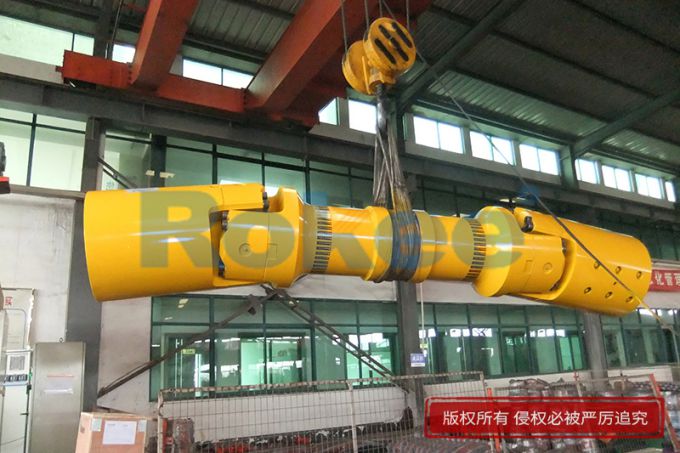
Rokee® Customized Bearing Seat Type 650 Universal Joint Shaft for Customers, Rokee® is a well-known high-quality supplier of couplings and technical services in China.
As a key component in modern mechanical transmission systems, the universal joint shaft with bearing seat can compensate for various deviations between shaft systems while transmitting torque. It is widely used in heavy industries such as metallurgy, mining, lifting and transportation, and petrochemicals.
The universal joint with a bearing seat is an efficient transmission device, whose core function is to achieve continuous rotation and reliable transmission of torque and motion in the presence of an angle between the two axis lines. A typical universal joint with a bearing seat is composed of main components such as a universal joint fork, a cross shaft, a bearing seat, and bearings. Among them, the cross shaft serves as a key connecting component, which is connected to two universal joint forks through needle roller bearings, forming a hinged structure that can rotate in multiple directions. This unique design enables the coupling to compensate for axial, radial, and angular deviations, with a maximum axis angle of 10 ° -45 °, depending on the structural type and specifications of the coupling.
The universal joint of the bearing seat utilizes the spatial hinge characteristics of the cross shaft to achieve power transmission. When the driving shaft rotates, the first universal joint fork drives the cross shaft to rotate, and the cross shaft then drives the second universal joint fork, thereby transmitting power to the driven shaft. During this process, the cross shaft can freely swing within the bearing seat to adapt to the angular deviation between the two shafts. It is worth noting that the single cross axis universal joint will generate additional dynamic loads and speed fluctuations during the transmission process. Therefore, in practical applications, a double joint structure is often used, which connects two universal joints through an intermediate shaft to eliminate speed fluctuations and improve transmission stability.
As a key component for supporting and fixing cross axis bearings, the structure of the bearing seat directly affects the reliability and maintenance convenience of the coupling. Modern bearing seats are mainly divided into two types: integral and split. The integral bearing seat has a simple structure and good rigidity, and is commonly used for light loads or small couplings; The split bearing seat greatly simplifies the bearing replacement process by designing the bearing seat as two separable parts, without the need to disassemble the entire coupling for maintenance, making it particularly suitable for heavy equipment and difficult to disassemble working conditions. The bearing seat is usually equipped with lubrication channels and sealing structures inside, ensuring that the needle roller bearing can receive sufficient lubrication even in harsh environments and preventing the invasion of pollutants.
The key component materials of the bearing seat universal joint directly determine the product performance and service life. Cross shafts are generally made of high-quality alloy steels such as 20CrMnTi and 20CrNi2Mo. After carburizing and quenching treatment, the surface hardness reaches HRC58-62, and the core maintains the toughness of HRC35-40, ensuring both wear resistance and impact resistance requirements. The universal joint fork is mostly made of 42CrMo or 35CrMo, and the best comprehensive mechanical properties are obtained through quenching and tempering heat treatment. The bearing seat is usually made of high-strength cast iron or cast steel, and forged alloy steel can also be used to improve structural strength under heavy load conditions. The needle roller bearings are made of GCr15 bearing steel, and some high-end products use ceramic needle rollers to enhance durability under extreme working conditions.
Universal couplings with bearing seats can be classified into various types based on their structural form and application characteristics, each with its unique performance advantages and applicable scenarios. The most common classification method is based on the structure of the bearing seat, mainly including two series: SWC type integral fork cross shaft universal joint and SWP type split bearing seat cross shaft universal joint. The SWC type adopts an integral fork head design, completely abandoning the bolted connection structure, eliminating the weak link of traditional bolt clamping bearing seats, and solving the problem of equipment failure caused by loose or broken bolts, thereby greatly improving operational stability. The service life of this structure is extended by 30% -50% compared to other types of couplings, making it particularly suitable for heavy-duty equipment such as rolling mills and cold beds in metallurgical machinery.
Over the years, with excellent quality, we have been continuously providing many coupling products of various categories and uses complying with multiple standards and a full range of services, from the product selection to final installation and operation, for the industry fields of ferrous metallurgy, nuclear power, gas turbine, wind power, ropeway construction, lifting transportation, general equipment, etc. We strictly comply with quality system requirements and implement the whole process control to become a reliable and trustworthy partner of customers.
URL: https://m.rokee.com/coupling-cases/bearing-seat-type-650-universal-joint-shaft.html