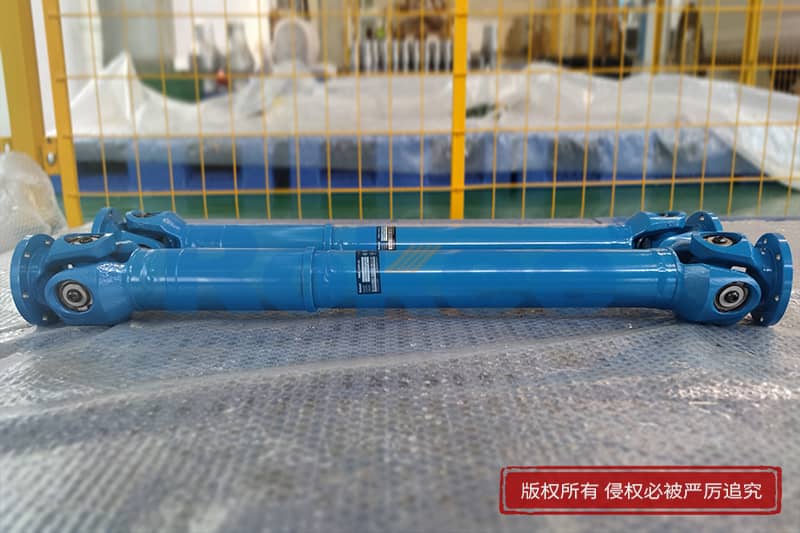
Rokee® Customized Long Type Universal Shafts for Customers, Rokee® is a well-known high-quality supplier of couplings and technical services in China.
As a key component in mechanical transmission systems, long universal shafts play a crucial role in modern industrial fields. It can efficiently transmit torque and rotational motion in the presence of angular deviation between axes, solving the problem of power transmission in complex mechanical layouts.
Long type universal shaft, professionally known as "long type universal shaft", is a mechanical transmission component specifically designed for long-distance power transmission. Compared with ordinary universal shafts, it has greater axial compensation capability and higher critical speed, which can adapt to more complex installation environments and more demanding working conditions.
Structurally, a typical long universal shaft is composed of several core components that are precisely matched together. The cross shaft is one of the most critical components, usually forged from high-strength alloy steel, with four shaft necks distributed in a cross shape, forming the core rotating joint of the universal shaft. The universal shaft fork (also known as the yoke head) is responsible for connecting the drive shaft and the cross shaft, usually used in pairs and fixed on the input shaft and output shaft respectively. The telescopic sleeve and spline shaft form an axial compensation mechanism, allowing the length of the transmission shaft to change during operation. This feature is particularly important for long-distance transmission, as it can compensate for axial dimension changes caused by installation errors, temperature deformation, or equipment displacement. The bearing components (mostly needle roller bearings) are installed on the cross shaft neck to reduce friction and support rotating parts. Their quality and lubrication condition directly affect the service life of the entire universal shaft. In addition, flanges or connecting keyways are used to firmly connect the universal shaft to the drive shaft and the driven shaft, ensuring effective torque transmission.
The special feature of a long universal shaft lies in its elongated shaft tube design, which allows it to transmit power between two devices that are far apart. Shaft tubes are usually made of high-quality seamless steel pipes, which undergo precision machining and dynamic balance testing to ensure that there is no excessive vibration during high-speed rotation. According to whether it has axial expansion and contraction function, long universal shafts can be divided into two types: fixed length type and expandable type. The latter achieves axial movement through spline cooperation and has stronger adaptability.
In terms of material selection, high-quality long universal shafts are often made of 45 grade steel or alloy steel, which have excellent strength, toughness, and wear resistance. For particularly demanding work environments, such as corrosive environments, stainless steel materials are also used. High end products also undergo quenching and tempering heat treatment on key components to achieve a surface hardness of HRC50-55, while maintaining the toughness of the core, thereby significantly extending its service life. Special surface treatment processes such as carburizing or nitriding are usually used on the bearing parts to enhance their wear resistance.
The core function of a long universal shaft is to solve the problem of power transmission between two shafts with angular deviation, and its working principle is based on spatial geometric kinematics. When the driving shaft rotates, the torque is transmitted to the cross shaft through the first universal shaft fork, and the cross shaft then transmits the rotational motion to the second universal shaft fork, ultimately driving the driven shaft to rotate. During this process, although the two axis centerlines are not on the same straight line and there is a certain angle, continuous power transmission can still be achieved.
It is worth noting that single universal shaft transmission has inherent motion characteristics - unequal speed. That is to say, when the input shaft rotates at a constant angular velocity, the angular velocity of the output shaft will exhibit periodic fluctuations, and the amplitude of the fluctuations is proportional to the size of the angle between the two axes. This inequality is particularly pronounced when the angle is large, which may cause vibration and noise in the transmission system. To solve this problem, a dual universal shaft arrangement is commonly used in practical applications, which involves connecting two universal shafts with an intermediate shaft, and through reasonable arrangement, the "speed fluctuation" of the first universal shaft is offset by the second universal shaft, thereby achieving synchronous rotation of the input shaft and output shaft.
The technical advantages of long universal shafts are mainly reflected in several aspects: firstly, the ability to compensate for angles. ordinary universal shafts generally allow a deflection angle of 5 ° -15 °, while specially designed long universal shafts can reach 25 ° or even greater; Next is the axial compensation capability, which allows for axial displacement of tens of millimeters or even longer through the expansion spline structure; Furthermore, the critical speed is high, and by optimizing the aspect ratio and precision dynamic balancing, the vibration problem during high-speed rotation is reduced. These characteristics make long universal shafts an ideal choice for mining machinery, engineering vehicles, and large industrial equipment.
From a dynamic perspective, when a long universal shaft transmits torque, contact stress is generated between the cross shaft neck and the bearing, while the universal shaft fork is subjected to alternating bending stress. Good lubrication can significantly reduce friction and wear, and extend service life. In addition, long universal shafts are also affected by centrifugal force during operation, especially at high speeds, which may cause changes in bearing clearance and affect transmission accuracy. Therefore, for high-speed applications, it is necessary to choose universal shaft products that have undergone special balancing treatment.
Long universal shafts can be classified into various types based on their structural characteristics and functional requirements, each with its specific application scenarios and advantages. Understanding these classifications can help select the most suitable products in practical engineering.
The cross axis long universal shaft is the most common type, characterized by a simple structure, strong load-bearing capacity, and easy maintenance. According to specific structural differences, it can be divided into SWC type (integral fork head), SWP type (partial bearing seat), and SWZ type (integral bearing seat) series. Among them, SWP-E type is a long cross shaft universal shaft with a telescopic flange, which is particularly suitable for industries such as metallurgy, lifting, and engineering transportation. It can operate stably under conditions of β ≤ 5 °~10 ° and adopts a split bearing seat cover structure, making it easy to quickly replace bearings.
The cage type long universal shaft adopts the principle of spherical hinge, which has the characteristics of smooth transmission and high efficiency. It allows for a large angle between the two axes and theoretically does not have the problem of non constant velocity of a single cross axis universal shaft. This type is commonly used in high-speed precision transmission applications, such as the drive shaft of luxury cars. Six steel balls are usually installed inside the cage type universal shaft, which are respectively installed in the space formed by the combination of inner and outer raceways. Power is transmitted through the steel balls, and a shaft to shaft angle of up to 42 ° can be achieved.
From the perspective of functional configuration, long universal shafts can be divided into two categories: non extendable and extendable. The SWC-1D type non expandable long universal shaft is a typical representative of the former, with a transmission shaft length range of 500-1690mm, a nominal torque of up to 90015N · m, and an allowable speed of 5015r/m. It is suitable for situations with fixed wheelbase. The expandable type has a built-in spline pair, allowing for relative axial movement, compensating for installation errors and thermal deformation, and is more suitable for application environments where axial displacement may occur.
According to size and load-bearing capacity, long universal shafts can be divided into four levels: heavy, medium, light, and small. Heavy duty products are mainly used in high torque applications such as metallurgical rolling mills and mining machinery; Medium sized vehicles are commonly found in construction machinery and heavy vehicles; Lightweight and compact are mostly used for general mechanical equipment and precision transmission systems. Taking the SWC series as an example, its specifications range from SWC160 to SWC490, and the matching cross bearing parameters also change accordingly. For example, SWC160 has a diameter of 65mm for M and 136mm for H, while SWC490 reaches a diameter of 210mm for M210mm and 419mm for H419mm.
The key performance parameters of a long universal shaft include: nominal torque (representing the amount of torque that can be continuously transmitted), allowable speed (related to the dynamic balance accuracy of the universal shaft), axis angle (maximum allowable angle between the two axes), axial compensation (the movable distance of the telescopic type), and service life (usually measured by the operating hours of the bearing).
Over the years, with excellent quality, we have been continuously providing many coupling products of various categories and uses complying with multiple standards and a full range of services, from the product selection to final installation and operation, for the industry fields of ferrous metallurgy, nuclear power, gas turbine, wind power, ropeway construction, lifting transportation, general equipment, etc. We strictly comply with quality system requirements and implement the whole process control to become a reliable and trustworthy partner of customers.
URL: https://m.rokee.com/coupling-cases/long-type-universal-shafts.html