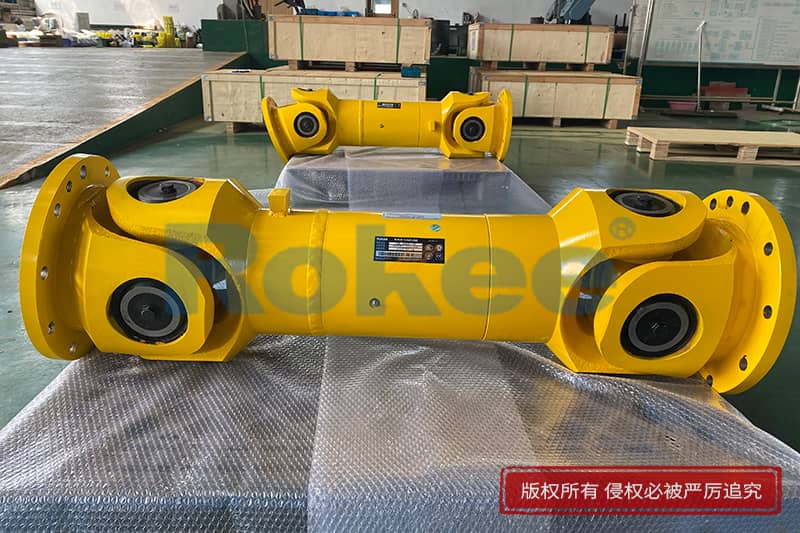
Rokee® Customized SWC Cross Universal Transmission Shaft for Customers, Rokee® is a well-known high-quality supplier of couplings and technical services in China.
SWC cross universal transmission shaft is a key component in modern industrial transmission systems, widely used in metallurgy, mining, lifting and transportation, and other fields due to its excellent angle compensation ability, high torque transmission efficiency, and reliable and stable performance.
The SWC cross axis universal drive shaft is a precision mechanical transmission device, whose core function is to achieve efficient power transmission between two shafts with angular deviation or axial displacement. This type of transmission shaft adopts a unique integral fork head bolt free connection structure, which significantly improves the structural strength and operational reliability compared to traditional bolt compression design. From the perspective of structural composition, the SWC cross universal transmission shaft is mainly composed of key components such as the cross shaft assembly, universal joint fork, expansion spline sleeve, and flange connection. Each component has undergone precision machining and special heat treatment processes to ensure superior overall performance.
The cross shaft assembly is the core component of the transmission shaft, usually made of high-strength alloy steel (such as 20CrMnTi or 40Cr), and subjected to heat treatment processes such as carburizing and quenching to achieve a surface hardness of HRC58-62, while the core maintains sufficient toughness. The four necks are distributed in a cross shape, with extremely high precision requirements. The cylindricity error of the necks is usually controlled within 0.005mm. Bearing components often use needle roller bearings or tapered roller bearings, combined with special sealing structures, to ensure load-bearing capacity and extend service life. The universal joint fork head adopts integral forging technology to avoid potential defects in the welding structure. The material is mostly 42CrMo or similar high-strength alloy steel, which is subjected to quenching and tempering heat treatment to obtain the best comprehensive mechanical properties.
The working principle of SWC cross universal transmission shaft is based on spatial kinematics principles. When the driving shaft rotates, the torque is transmitted to the cross shaft through the first universal joint fork, and the cross shaft then transmits the rotational motion to the second universal joint fork, ultimately driving the driven shaft to rotate. During this process, although the two axis centerlines are not on the same straight line and there is a certain angle, continuous power transmission can still be achieved. It is worth noting that single universal joint transmission has inherent non-uniformity, that is, when the input shaft rotates at a constant angular velocity, the angular velocity of the output shaft will fluctuate periodically. To solve this problem, SWC type transmission shafts often adopt a dual universal joint arrangement, which allows the speed fluctuation of the first universal joint to be offset by the second universal joint through reasonable arrangement, thereby achieving synchronous rotation of the input shaft and output shaft.
The angle compensation capability of SWC transmission shaft is an important technical indicator, generally allowing for shaft to shaft angles of 5 ° -15 °, and special designs can reach 25 ° or even larger. This compensation capability enables it to adapt to equipment installation errors, foundation settlement, and structural deformation during operation. At the same time, through the telescopic spline structure, the SWC transmission shaft can also compensate for axial displacement, with displacement ranging from tens of millimeters to hundreds of millimeters depending on the model, which is particularly important for applications with thermal expansion or equipment movement.
From a dynamic perspective, the SWC cross universal transmission shaft is subjected to complex stress states during operation: contact stress is generated between the cross shaft neck and the bearing, the universal joint fork is subjected to alternating bending stress, and the spline part is simultaneously subjected to torsion, compression, and wear. Good lubrication can significantly reduce friction and wear, and extend service life. In addition, the transmission shaft is also affected by centrifugal force during high-speed rotation, which may cause changes in bearing clearance and affect transmission accuracy. Therefore, for high-speed applications, it is necessary to choose transmission shaft products that have undergone special dynamic balancing treatment, and the residual unbalance is usually controlled within the range of 1-2.5g · mm/kg.
The structural innovation of SWC cross universal transmission shaft is reflected in multiple aspects: the overall fork design eliminates the weak links of traditional bolt connection structure; Optimized bearing sealing system prevents lubricant leakage and contamination from entering; Modular design makes maintenance and replacement more convenient; Surface treatment techniques such as phosphating and chrome plating have improved corrosion resistance. These technological innovations collectively contribute to the outstanding performance of SWC drive shafts in heavy loads, high speeds, and harsh environments.
From a basic structural perspective, the SWC series mainly includes the following typical models:
SWC-BH type: standard telescopic welded type, with universal joint fork and shaft tube connected by welding, and spline sleeve can be axially extended and retracted, making it the most commonly used universal structure. Suitable for most transmission applications that require angle and axial compensation, such as engineering machinery, metallurgical equipment, etc. Its characteristics are compact structure, high load-bearing capacity, and allowable radial deviation is generally 0.2-1.2mm, with angular deviation of 1 ° -15 °.
SWC-WH type: Non expansion welding type, with universal joint fork head and shaft tube welded and fixed, without axial expansion function. Suitable for occasions with fixed wheelbase, such as ship propulsion systems, fixed pump sets, etc. This structure has higher torsional stiffness and better transmission accuracy due to the elimination of expansion splines, but its compensation capability is relatively limited.
SWC-CH type: long telescopic welded type, with an extended spline sleeve structure and greater axial compensation. Especially suitable for equipment with long-distance axial movement or large thermal expansion, such as rolling mills, large mining machinery, etc. The axial displacement compensation can reach 300-800mm, or even longer.
SWC-DH type: Short telescopic welding type, with a more compact structure, suitable for situations with limited installation space. Compared to the BH type, the axial compensation amount is smaller but the radial size is smaller, which is commonly used in compact application environments such as lifting equipment and locomotive transmission systems.
SWC-WF type: Non expansion flange type, with flange connections at both ends, the overall structure is the most rigid. Suitable for high-precision transmission and applications that do not require axial compensation, such as precision machine tools, testing equipment, etc. The flange connection method is also easy to disassemble and maintain.
The SWC cross universal transmission shaft has demonstrated excellent technical performance in the industrial transmission field, and its unique design brings a series of advantages that traditional couplings cannot match. These performance characteristics make it the preferred transmission solution for heavy loads, high speeds, and complex operating conditions, meeting the increasingly high requirements of modern industrial equipment for transmission systems.
The SWC cross universal transmission shaft has excellent load-bearing capacity and can transmit greater torque than traditional types such as gear couplings under the same rotation diameter conditions. This is mainly due to its integral fork design and optimized stress distribution structure, which greatly improves material utilization.
By adopting an integral fork head without bolt design, the SWC transmission shaft fundamentally eliminates the weak links of traditional bolt connection structures. Loose or broken bolts were once the main cause of coupling failures, and SWC's innovative structure greatly improves reliability. Practical applications have shown that under the same operating conditions, the service life of SWC transmission shafts is extended by 30% -50% compared to traditional structures, which means fewer replacement times and lower maintenance costs.
The SWC drive shaft also has good overload protection characteristics. When the equipment experiences abnormal overload, the transmission shaft will undergo elastic deformation to absorb some of the impact energy. If the overload persists, the spline part will usually slip first, thus protecting the more expensive main and driven machines from damage. This' sacrificial protection 'mechanism helps prevent larger equipment accidents in practice.
Over the years, with excellent quality, we have been continuously providing many coupling products of various categories and uses complying with multiple standards and a full range of services, from the product selection to final installation and operation, for the industry fields of ferrous metallurgy, nuclear power, gas turbine, wind power, ropeway construction, lifting transportation, general equipment, etc. We strictly comply with quality system requirements and implement the whole process control to become a reliable and trustworthy partner of customers.
URL: https://m.rokee.com/coupling-cases/swc-cross-universal-transmission-shaft.html