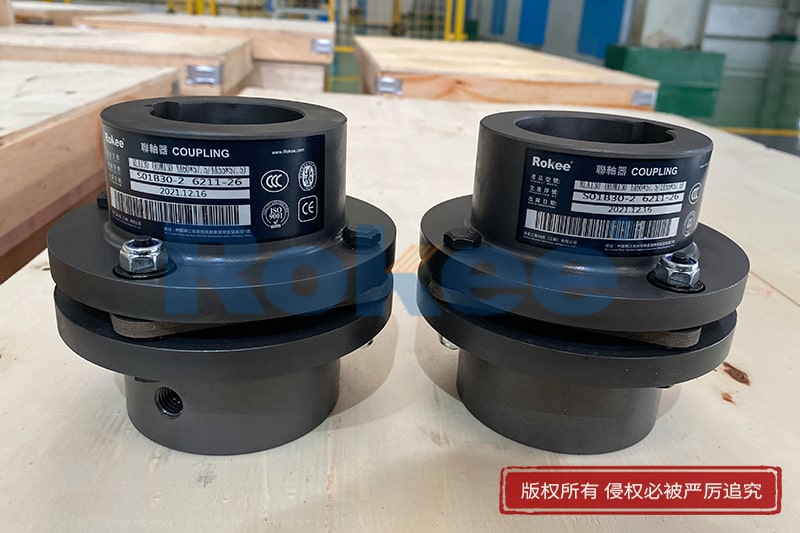
Rokee® Customized RLA Flexible Diaphragm Coupling for Customers, Rokee® is a well-known high-quality supplier of couplings and technical services in China.
As a representative product of metal elastic element couplings, RLA flexible diaphragm couplings have become a core component in modern industrial transmission systems due to their unique structural design and excellent performance. This type of coupling achieves torque transmission and deviation compensation through precision designed stainless steel diaphragm groups, demonstrating irreplaceable technical value in fields such as aerospace, energy equipment, and precision machinery.
The innovative structure of RLA flexible diaphragm coupling is the basis of its excellent performance. Its design combines the essence of material science and mechanical engineering. The typical RLA model consists of three core components: high-strength wheels, special diaphragm groups, and precision connection systems, each optimized to meet the demands of harsh working conditions.
The wheel hub components are made of high-strength aluminum alloy or alloy steel (42CrMo4) and undergo precision machining and dynamic balancing treatment. The wheel hub design includes various forms of shaft holes:
Clamping type (no keyway required, easy to install)
Keyway type (more reliable for heavy-duty transmission)
Cone sleeve type (convenient for precise positioning)
The diaphragm group, as the core elastic element, is usually made of AISI 301/304 stainless steel thin plates (thickness 0.2-0.5mm) stacked in multiple layers. The shape of the membrane has been optimized by finite element method, and commonly includes:
Hexagonal (standard type, balancing rigidity and flexibility)
Circular (high torsional stiffness)
Triangle (large angle compensation)
Each group of membranes consists of 4-12 stacked pieces, which are pre tightened and connected using special bolt groups. The bolts are made of 12.9 grade alloy steel and have undergone Dacromet treatment on the surface to ensure corrosion resistance and fastening reliability. The unique arrangement of the membrane group enables it to simultaneously produce bending, stretching, and compression deformations, thereby achieving intelligent compensation for multi-directional deviations.
The working principle of RLA coupling is based on metal elasticity: when the driving shaft transmits torque, the torque is transmitted to the driven shaft through the force flow path composed of the hub bolt diaphragm. When there is relative displacement between the two axes, the diaphragm group undergoes controllable elastic deformation:
Axial displacement: The diaphragm undergoes tensile/compressive deformation
Radial displacement: The diaphragm exhibits fan-shaped bending
Angular deviation: The membrane forms a conical deformation
This deformation not only achieves displacement compensation, but also absorbs vibration energy (with a damping effect of up to 30%). Unlike rubber component couplings, the deformation of metal diaphragms is completely within the elastic range, without creep or aging issues, ensuring long-term stable transmission performance.
Over the years, with excellent quality, we have been continuously providing many coupling products of various categories and uses complying with multiple standards and a full range of services, from the product selection to final installation and operation, for the industry fields of ferrous metallurgy, nuclear power, gas turbine, wind power, ropeway construction, lifting transportation, general equipment, etc. We strictly comply with quality system requirements and implement the whole process control to become a reliable and trustworthy partner of customers.
URL: https://m.rokee.com/coupling-cases/rla-flexible-diaphragm-coupling.html