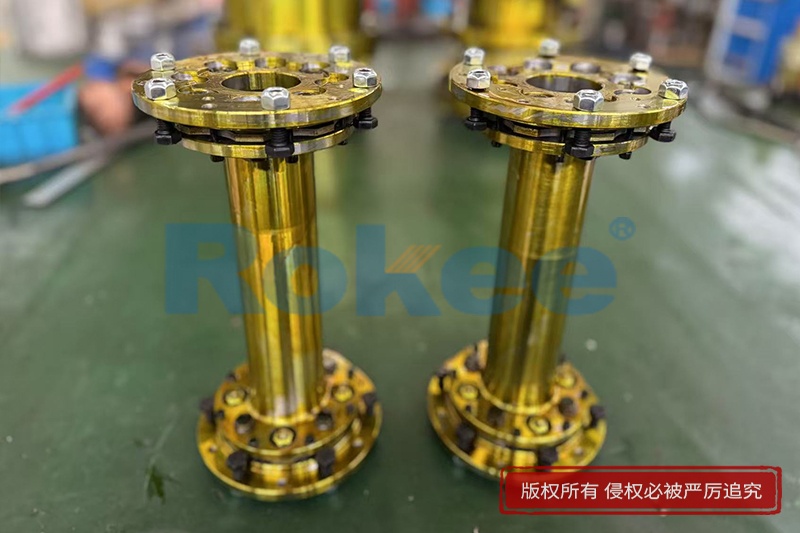
Rokee® Customized High Speed Diaphragm Coupling for Customers, Rokee® is a well-known high-quality supplier of couplings and technical services in China.
As a key component in modern industrial transmission, high-speed diaphragm couplings play an irreplaceable role in various high-speed rotating equipment. This type of coupling achieves power transmission and deviation compensation through the elastic deformation of the metal diaphragm, perfectly solving many limitations of traditional couplings under high-speed working conditions.
High speed diaphragm coupling is a high-performance metal elastic element flexible coupling, which represents the advanced level of modern coupling technology. Compared with traditional couplings, high-speed diaphragm couplings eliminate the need for lubrication of sliding parts and gear meshing structures, and instead use a diaphragm group composed of multiple layers of stainless steel sheets as the core transmission component. This innovative design enables it to effectively compensate for axial, radial, and angular deviations between shaft systems while transmitting torque, adapting to various complex working environments.
The working principle of high-speed diaphragm couplings is based on the theory of metal elastic deformation. When the driving shaft rotates, the torque is transmitted to the diaphragm group through the bolt group, and the diaphragm undergoes elastic deformation and transmits the torque to the driven shaft. During this process, the flexible design of the membrane allows for a certain relative displacement between the two axes, including axial displacement (up to ± 0.5mm), radial displacement (up to ± 0.3mm), and angular displacement (up to ± 1.5 °). This compensation capability greatly reduces the precision requirements for installation alignment and also reduces the additional load caused by shaft deformation.
In terms of transmission characteristics, high-speed diaphragm couplings exhibit zero backlash and high torsional stiffness. Unlike gear couplings with backlash or elastic couplings with damping characteristics, diaphragm couplings can provide almost rigid and precise transmission, making them particularly suitable for servo systems that require high dynamic response performance. Meanwhile, its torsional stiffness increases with the increase of the number of membrane groups, and the multi membrane structure can meet the requirements of high torque transmission.
The structural design of high-speed diaphragm couplings fully embodies the concept of precision and efficiency in mechanical engineering. Its typical structure mainly consists of three parts: two shaft sleeves (or hubs) and a diaphragm group in the middle. The shaft sleeve is usually made of high-strength alloy steel and connected to the equipment shaft end through keyway, expansion sleeve or flange; The membrane group is composed of multiple layers of ultra-thin stainless steel sheets (usually 0.2-0.5mm thick) stacked together, and is alternately fixed on both sides of the shaft sleeve by precision bolts. Behind this seemingly simple structure lies exquisite engineering design, and every detail directly affects the final performance of the coupling.
As the core elastic component of the coupling, the shape design of the diaphragm is particularly critical. Common membrane shapes include circular ring shape, waist waist shape, and polygonal connecting rod shape. The circular membrane structure is simple and easy to manufacture, but its compensation capability is relatively limited; The waist cinched membrane improves flexibility and can withstand greater relative displacement through a waist thinning design; The multi link diaphragm (such as four, six, and eight links) provides excellent deviation compensation capability while maintaining high stiffness. Engineers will choose the appropriate diaphragm shape based on speed, torque, and deviation compensation requirements, and sometimes even combine different shapes of diaphragms to achieve the best performance balance.
In terms of connection methods, high-speed diaphragm couplings provide multiple options to adapt to different application scenarios. The most common shaft hole connections include keyway cylindrical holes, tapered holes, and expansion sleeve connections. The keyway connection is simple and reliable, but it requires high precision in the machining of the shaft and keyway; The conical hole connection achieves self centering through the cooperation of conical surfaces, making assembly and disassembly convenient; The expansion sleeve connection does not require a keyway at all, and achieves seamless transmission through the huge clamping force generated by the bolt, which is particularly suitable for ultra-high precision applications. Modern high-speed diaphragm couplings have also developed a modular design concept, allowing users to combine intermediate sections of different lengths and diaphragm groups of different specifications according to their actual needs, greatly improving the adaptability and economy of the product.
The high-speed diaphragm coupling, with its unique design concept and precision manufacturing process, has demonstrated comprehensive performance advantages in the field of mechanical transmission. These advantages make it stand out in competition with other types of couplings and become the preferred solution for high-speed and high-precision application scenarios.
Over the years, with excellent quality, we have been continuously providing many coupling products of various categories and uses complying with multiple standards and a full range of services, from the product selection to final installation and operation, for the industry fields of ferrous metallurgy, nuclear power, gas turbine, wind power, ropeway construction, lifting transportation, general equipment, etc. We strictly comply with quality system requirements and implement the whole process control to become a reliable and trustworthy partner of customers.
URL: https://m.rokee.com/coupling-cases/high-speed-diaphragm-coupling.html