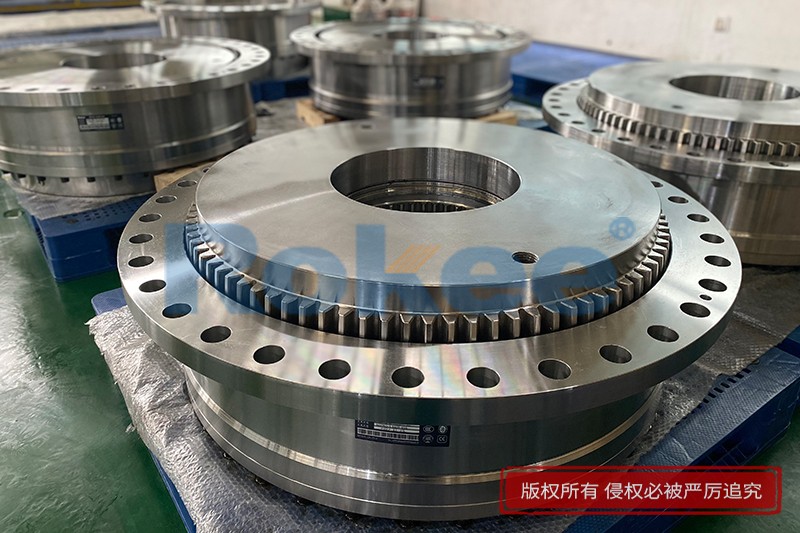
Rokee® Customized Flange Gear Type Couplings for Customers, Rokee® is a well-known high-quality supplier of couplings and technical services in China.
As a key component in mechanical transmission systems, flange gear type couplings play an indispensable role in modern industrial fields. This type of coupling cleverly combines the principle of gear meshing with flange connection, combining high torque transmission capability and good deviation compensation performance, making it an ideal choice for harsh working conditions such as heavy machinery and high-speed equipment.
The flange gear coupling is an important member of the gear coupling family, belonging to the category of flexible couplings, specifically designed to efficiently transmit torque and rotational motion between two shafts that may have certain deviations. The uniqueness of this type of coupling lies in its integration of the efficiency of gear transmission and the stability of flange connection. Power transmission is achieved through precise meshing of internal and external gears, while the flange and bolts are firmly connected, ensuring transmission accuracy and facilitating installation and maintenance.
Compared with traditional rigid couplings, flange gear couplings have significant technical advantages. It can effectively compensate for axial, radial, and angular deviations generated during installation and operation, avoiding vibration, noise, and premature component damage caused by poor alignment. At the same time, its multi tooth simultaneous meshing characteristic greatly improves the torque transmission capacity per unit volume, making it particularly suitable for heavy-duty applications with limited space. According to industry data, well-designed flange gear couplings can achieve a transmission efficiency of over 99.7%, a torque carrying capacity of up to 4500kN · m, a permissible parallel offset typically within the range of 0.01-0.02 inches, and a tolerance for misalignment of up to 2 degrees.
In terms of industrial application distribution, flange gear couplings almost cover all fields that require reliable power transmission. It can be seen in steel mills in the metallurgical industry, crushers in mining equipment, propulsion systems on offshore platforms, and large wind turbines in the field of new energy. Especially in situations where high-power motors and working machines need to be connected, such as water pumps, compressors, fans, etc., flange gear couplings have become the preferred solution for engineers due to their stable performance. With the advancement of materials science and manufacturing technology, the performance boundaries of such couplings are constantly expanding, and their application prospects are becoming increasingly broad.
The brilliance of the flange gear coupling lies in its unique mechanical structure design, where each component is carefully calculated and optimized to ensure efficient and reliable operation of the coupling. A deep understanding of its structural composition and working principle is crucial for correct selection, installation, and maintenance, which can maximize the performance of the coupling and extend its service life.
A typical flange gear coupling consists of four key components that form a precision fit system. The external gear shaft sleeve is the active component of the coupling, usually made of high-strength alloy steel and fixed at the end of the drive shaft through keyway or interference fit. The outer teeth are precision machined, and the tooth profile is generally involute. Some high-performance models adopt special drum shaped tooth designs. The surface of the external teeth undergoes heat treatment processes such as quenching or carburizing, and the hardness can reach HRC58-62, ensuring wear resistance and fatigue strength. The internal gear ring that meshes with the external gear is also made of high-quality steel, and the parameters of the internal teeth are precisely matched with the external teeth. The backlash between the two is slightly larger than that of the standard gear pair to accommodate a certain amount of shaft deviation. The outer side of the inner gear ring is designed with a flange plate, on which bolt holes are evenly distributed for connecting with the other half of the coupling.
The flange sleeve component is the characteristic of the flange gear coupling, which perfectly combines gear meshing and flange connection. The sleeve is usually divided into two halves and fastened together with high-strength bolts to form a rigid connection. The inner wall of the sleeve is machined with internal teeth, forming a meshing pair with the external gear shaft sleeve. The machining accuracy of the flange connection surface is extremely high, and the flatness error is generally controlled within 0.02mm to ensure uniform transmission of force flow. To meet the requirements of different working conditions, the flange sleeve has two designs: continuous sleeve and split sleeve. The former has a more compact structure, while the latter is easier to install and maintain. The sealing system is also a key component, including end caps, O-rings, and grease fittings, to prevent lubricant leakage and contamination, ensuring that the gear meshing surface is in good lubrication condition for a long time.
The working principle of flange gear coupling is based on gear meshing mechanics, but it is different from ordinary gear transmission. When the drive shaft rotates, torque is transmitted to the outer gear sleeve through a key connection, and the teeth of the outer gear sleeve mesh with the teeth of the inner gear ring, transmitting force to the flange sleeve, and then transmitted to the flange sleeve and inner gear ring on the other side through a bolt connection, ultimately reaching the driven shaft. Throughout the entire transmission process, multiple pairs of teeth participate in the work simultaneously, forming a load sharing mechanism that significantly improves torque transmission capability and operational stability.
The ability to compensate for shaft deviation is the core advantage of flange gear couplings. When there is a radial offset between the two shafts, the outer gear sleeve can make slight radial movements inside the inner gear ring. Due to the reserved clearance on the tooth side and special tooth profile design (such as drum teeth), this offset will not cause the tooth surface to jam or stress concentration. When the angle is not centered, the spherical tooth tip of the drum shaped gear coupling allows the outer gear sleeve to produce a certain degree of deflection inside the inner gear ring, up to a maximum of 6 degrees (generally recommended for use within the range of 1.5 ° to 2.5 °). Axial displacement is compensated by sliding in the tooth width direction, and a well-designed coupling can allow for several millimeters of axial displacement. This three-dimensional compensation capability enables flange gear couplings to adapt to installation errors and shaft deformations that are difficult to avoid in practical engineering, protecting precision components such as bearings and mechanical seals from additional loads.
Over the years, with excellent quality, we have been continuously providing many coupling products of various categories and uses complying with multiple standards and a full range of services, from the product selection to final installation and operation, for the industry fields of ferrous metallurgy, nuclear power, gas turbine, wind power, ropeway construction, lifting transportation, general equipment, etc. We strictly comply with quality system requirements and implement the whole process control to become a reliable and trustworthy partner of customers.
URL: https://m.rokee.com/coupling-cases/flange-gear-type-couplings.html