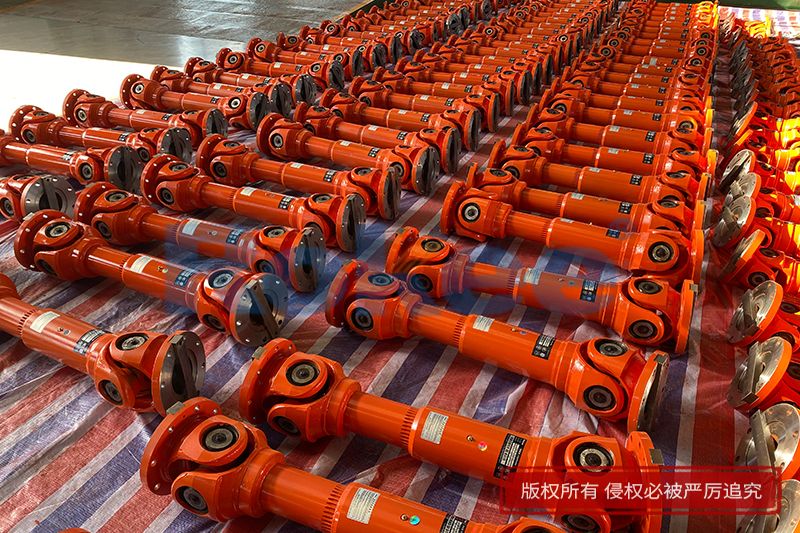
Rokee® Customized Cardan Shafts For Steel Mills for Customers, Rokee® is a well-known high-quality supplier of couplings and technical services in China.
The cardan shaft used in steel mills is a key component that connects the transmission system of the rolling mill with the rolling mill rolls, undertaking the dual mission of transmitting huge torque and adapting to changes in the position of the rolling mill rolls. In the process of steel production, cardan shafts need to cope with extreme working conditions such as high temperature, heavy load, and impact, and their performance directly affects the working efficiency of the rolling mill and the quality of steel products. According to different structures and working principles, cardan shafts used in steel mills are mainly divided into two categories: slide type cardan shafts and cross axis cardan shafts, each of which has multiple derivative models to adapt to different rolling scenarios.
The characteristics of the working environment determine that the cardan shaft of the steel plant must have special performance. During the steel rolling process, the cardan shaft is often subjected to a high-temperature radiation environment of 800-1200 ℃, while also bearing periodic impact loads, with instantaneous torque fluctuations up to 2-3 times the average value. Taking the medium thick plate rolling mill as an example, the rolling force can reach tens of thousands of kilonewtons, and the peak torque transmitted by the cardan shaft often exceeds 10000 kN · m. In addition, frequent adjustments of the rolling mill lead to continuous changes in the working angle of the cardan shaft. The inclination angle α of conventional models of cardan shafts is usually controlled within the range of 5 ° -10 °, while specially designed models such as SWP-F large telescopic cardan shafts can allow the axis to bend at an angle of more than 10 °.
Universal shafts used in steel mills can be classified into various types based on structural differences, each with its unique advantages and application scenarios. Sliding cardan shaft shaft is the most common type in traditional rolling mills, which achieves angle compensation through the sliding fit between the sliding block and the fork head. The four roll precision rolling mill of Jinan Iron and Steel Group's medium plate plant adopts this type of cardan shaft, which is characterized by a simple structure and low manufacturing cost, but requires regular replacement of vulnerable parts such as sliders. Practice has shown that by modifying the lower shaft balance positioning device and using heavy-duty four row tapered roller split bearings, the problem of axial movement of the rolling mill caused by such universal shafts can be effectively solved, significantly reducing the axial movement of the main motor rotor.
The cross axis cardan shaft is more widely used in modern steel plants. The SWP series is a typical representative, among which the SWP-F type large expansion single cross shaft cardan shaft adopts a 35CrMo alloy steel quenched and tempered shaft body and a 20CrMnTi material cross shaft, with a large extension and contraction of 150mm, especially suitable for the metallurgical industry. This type of coupling improves wear resistance through a multi row needle roller structure and is equipped with a dedicated oil nozzle to ensure lubrication effect. The nominal torque can reach 16kN · m. The larger SWP-ZG positive flange through type cross shaft cardan shaft has a turning diameter of 200-285mm, a nominal torque of 40kN · m, and a fatigue torque of 16kN · m, and is widely used in steel rolling machinery and lifting and transportation machinery.
Special consideration is required for adapting to special working conditions. High temperature areas should use heat-resistant alloy steel and increase lubrication frequency; In dusty environments, enhanced sealing is required, using labyrinth or rubber lip seals; Priority should be given to using stainless steel materials or special coatings in corrosive atmospheres.
The cardan shaft of steel mills operates under harsh working conditions, and various faults are inevitable. Timely identification and handling of these problems are crucial to ensuring production. The common failure modes mainly include bearing wear, cross shaft fracture, spline pair damage, and balance failure. Bearing wear is the most common fault, manifested as abnormal temperature rise and increased vibration, often caused by poor lubrication or the invasion of impurities. In the case of Jinan Iron and Steel, the axial displacement of the rolling mill caused by the deflection torque of the cardan shaft shaft is a typical bearing failure problem, which was solved by using heavy-duty four row tapered roller split bearings. Cross axis fracture is more destructive, usually caused by fatigue accumulation or overload, with a shell like texture on the cross section. The SWP series cardan shaft emphasizes that the cross axis should be made of 20CrMnTi material and treated with carburizing and quenching to improve fatigue resistance.
Over the years, with excellent quality, we have been continuously providing many coupling products of various categories and uses complying with multiple standards and a full range of services, from the product selection to final installation and operation, for the industry fields of ferrous metallurgy, nuclear power, gas turbine, wind power, ropeway construction, lifting transportation, general equipment, etc. We strictly comply with quality system requirements and implement the whole process control to become a reliable and trustworthy partner of customers.
URL: https://m.rokee.com/coupling-cases/cardan-shafts-for-steel-mills.html