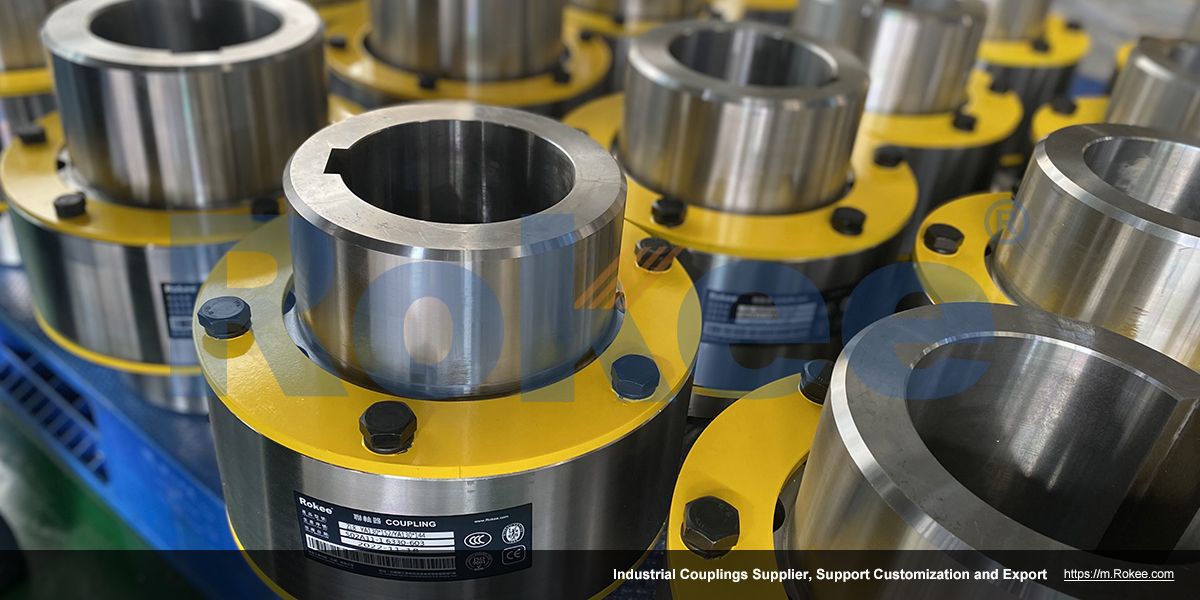
Bushed Pin Flexible Couplings
Rokee is a chinese Bushed Pin Flexible Couplings Manufacturer, provide Bushed Pin Flexible Couplings processing and customization services, Over the years, with excellent quality, we have been continuously providing many coupling products of various categories and uses complying with multiple standards and a full range of services, from the Bushed Pin Flexible Couplings selection to final installation and operation, for the industry fields of ferrous metallurgy, nuclear power, gas turbine, wind power, ropeway construction, lifting transportation, general equipment, etc. We strictly comply with quality system requirements and implement the whole process control to become a reliable and trustworthy partner of customers.
Providing customers with better Bushed Pin Flexible Couplings is always our driving force. Our aim is to transmit power for you and generate value for both of us. We look forward to joining you and becoming your partner for common progress.
-
![LT Bushed Pin Flexible Couplings,LT/TL Elastic Sleeve Pin Coupling]()
LT/TL Elastic Sleeve Pin Coupling
LT Elastic Sleeve Pin Coupling is the basic form of this series of couplings.View More -
![LTZ Bushed Pin Flexible Couplings,LTZ/TLL Elastic Sleeve Pin Coupling With Brake Wheel]()
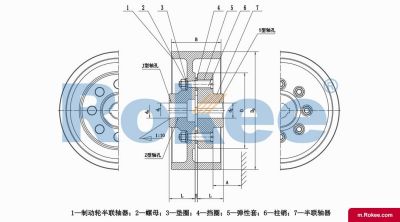
LTZ/TLL Elastic Sleeve Pin Coupling With Brake Wheel
LTZ Elastic Sleeve Pin Coupling is designed with a brake wheel, suitable for situations where braking is required.View More
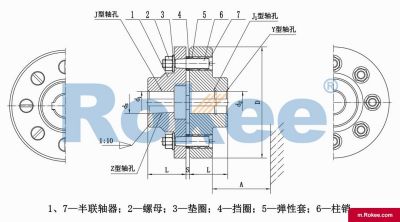
The bushed pin flexible coupling is an improved version of the flange coupling, and its core design lies in the combination of rubber bushing and pin.
Constitute
Two half coupling: usually a flange structure, connected by bolt holes.
Rubber lining: installed in bolt holes, providing elasticity and vibration reduction function.
Pin (column pin): Pass through the bushing, connect the two halves of the coupling, and transmit torque.
When there is a misalignment (axial, radial, or angular) between the two axes, the rubber sleeve absorbs displacement through elastic deformation, while buffering vibration and impact. The pin allows for slight sliding inside the sleeve, further reducing stress concentration caused by rigid contact.
Performance Characteristics
Displacement compensation capability: It can compensate for axial displacement (± 1-2mm), radial displacement (0.5-1mm), and angular deviation (± 0.5 °~1 °), and is suitable for situations with low precision requirements.
Vibration reduction and noise reduction: The high damping characteristics of rubber bushings can absorb high-frequency vibrations, reduce the noise of transmission systems, and are suitable for scenarios such as motor drive.
No lubrication required: non-metallic elastic element design, maintenance free, avoiding grease pollution to the environment.
Medium load adaptability: The transmission torque range is usually tens to thousands of Newton meters, suitable for small and medium power equipment such as water pumps, fans, and conveyors.
Application scenarios
Connection between electric motor and reducer: compensates for the alignment deviation during motor startup.
Industrial pump set: Reduce shaft vibration caused by fluid pulsation.
Automation equipment, such as conveyor belts and packaging machinery, requires low noise and flexible transmission.
Advantages:
The structure is simple, easy to install, and the cost is lower than that of metal elastic element couplings.
The rubber bushing is easy to replace and does not require disassembling the entire coupling.
Disadvantages:
Rubber is prone to aging, and high temperatures (>80 ℃) or oily environments can shorten its lifespan.
The compensation amount is limited and not suitable for large offset or heavy load impact conditions.
Selection parameters:
Torque requirement: A 20% safety margin needs to be reserved.
Speed limit: The centrifugal force of the rubber liner affects the speed, usually applicable for speeds ≤ 3000r/min.
Environmental temperature: Standard rubber bushings are suitable for -20 ℃~+60 ℃.
Maintenance suggestion:
Regularly check the wear of the lining, and replace it promptly if cracks or hardening occur.
Avoid long-term exposure of the coupling to ultraviolet or chemically corrosive environments.
The bushed pin flexible coupling plays an important role in industrial transmission due to its balanced performance and economy, especially suitable for small and medium-sized equipment that is sensitive to noise and has stable loads.
In the realm of mechanical power transmission, flexible couplings serve as indispensable components that bridge rotating shafts, mitigate misalignment stresses, dampen vibrational forces, and ensure seamless torque transfer across diverse industrial machinery. Among the broad spectrum of flexible coupling designs, the bushed pin flexible coupling stands out as a time-tested, versatile solution favored for its balanced blend of simplicity, durability, and functional adaptability. Unlike rigid couplings that demand perfect shaft alignment and offer no tolerance for operational displacement, this type of coupling integrates elastic elements to accommodate minor shaft mismatches, absorb shock loads, and reduce noise during operation, making it a staple in countless low-to-medium speed and torque transmission systems. To fully grasp its value in industrial engineering, it is critical to dissect its fundamental structural composition, inherent performance traits, distinct design variations, and the wide array of practical applications that leverage its unique capabilities.
At its core, the bushed pin flexible coupling features a straightforward yet robust structural framework, consisting of two primary metallic hubs (also referred to as half-couplings), a set of precision-engineered cylindrical pins, and resilient elastic bushings that encase each pin. The two hubs are typically crafted from high-strength carbon steel or alloy steel, chosen for their exceptional mechanical strength, wear resistance, and ability to withstand repeated torsional stresses without deformation; in some light-duty scenarios, cast iron hubs may be utilized for cost efficiency without compromising basic operational integrity. Each hub is machined with a series of evenly spaced radial holes around its outer flange, aligned symmetrically to accommodate the connecting pins. The elastic bushings, the heart of the coupling’s flexibility, are commonly fabricated from high-grade rubber, polyurethane, or nylon materials, selected for their superior elasticity, fatigue resistance, and ability to revert to their original shape after sustained compression or bending. These bushings are press-fitted onto the smooth surface of each steel pin, creating a cushioned interface between the rigid metal pins and the hub holes, eliminating direct metal-to-metal contact and preventing premature wear. During assembly, the pins with attached bushings are inserted through the aligned holes of both hubs, securely locking the two components together while maintaining a degree of radial and angular play enabled by the compressible elastic bushings. Notably, this design eliminates the need for complex lubrication systems or precision machining of mating surfaces, streamlining both manufacturing processes and on-site installation, disassembly, and routine maintenance procedures. The overall compact profile of the coupling also allows for easy integration into machinery with limited spatial constraints, a key practical advantage in crowded industrial setups.
The performance characteristics of the bushed pin flexible coupling are directly derived from its structural design, delivering a suite of functional benefits that address common pain points in power transmission systems. Foremost among these is its ability to compensate for multiple forms of shaft misalignment, a common occurrence in real-world machinery due to manufacturing tolerances, installation errors, thermal expansion, or operational wear. The elastic bushings flex and deform slightly to accommodate angular misalignment (where the two shaft axes intersect at a small angle), parallel misalignment (where the shaft axes remain parallel but offset), and limited axial displacement (where shafts move slightly along their central axis during operation), preventing concentrated stresses that could lead to shaft bending, bearing failure, or premature component breakdown. Beyond misalignment compensation, the coupling excels at shock absorption and vibration damping, critical for protecting delicate downstream equipment and extending the service life of entire drive systems. When subjected to sudden load spikes, intermittent impacts, or rotational vibrations generated by prime movers such as electric motors or internal combustion engines, the elastic bushings absorb and dissipate kinetic energy, reducing the transmission of harsh vibrations to connected machinery and minimizing operational noise. This damping effect also enhances the smoothness of power delivery, eliminating torsional fluctuations that can disrupt the precision of driven equipment.
Additional performance merits include high torsional rigidity paired with controlled flexibility, ensuring efficient torque transmission without excessive slippage or energy loss, even under moderate to heavy load conditions. The metallic hubs and pins provide the structural strength to handle consistent torque loads, while the elastic bushings maintain just enough compliance to preserve the coupling’s protective properties. The coupling also exhibits strong resistance to environmental factors, with proper material selection for bushings enabling operation across a moderate temperature range and tolerance for dust, moisture, and mild chemical exposure commonly found in industrial workshops and manufacturing facilities. Maintenance requirements are minimal compared to more complex flexible couplings, as the only wearable components are the elastic bushings, which can be quickly replaced without removing the entire coupling from the shafts or disassembling major machinery parts. This ease of maintenance reduces downtime and long-term operational costs, a significant advantage for industrial facilities prioritizing productivity and cost efficiency. It is important to note, however, that this coupling is optimized for low-to-medium rotational speeds and moderate torque loads; at extremely high speeds or under excessive heavy-duty torsional stresses, the elastic bushings may experience accelerated fatigue and wear, making it unsuitable for high-performance, high-speed drive systems without specialized design modifications.
While adhering to the core pin-and-bushing structural principle, bushed pin flexible couplings are available in several distinct varieties, each tailored to specific operational requirements, spatial constraints, and load conditions, expanding their versatility across diverse applications. The most common standard variant is the conventional flange-type bushed pin coupling, the baseline design featuring two solid flanged hubs with evenly distributed pin holes, ideal for general-purpose power transmission where shafts are positioned in close proximity and standard misalignment compensation is sufficient. This variant is the most widely produced and utilized, offering a cost-effective, all-around solution for countless light to medium-duty industrial drives. A second prominent variation is the spacer-type bushed pin flexible coupling, which incorporates a rigid metallic spacer between the two flanged hubs to increase the distance between connected shafts. This design addresses applications where a larger gap between driving and driven shafts is required, such as in pump systems, conveyor drives, or machinery with integrated gearboxes that demand additional axial space; the spacer maintains the coupling’s torsional strength while preserving the elastic bushing’s misalignment and damping capabilities.
A third specialized variant is the brake wheel-equipped bushed pin coupling, engineered to integrate a friction brake wheel directly onto one of the hubs, combining torque transmission and emergency braking functions into a single compact component. This design eliminates the need for separate braking hardware, making it ideal for material handling equipment such as hoists, cranes, and elevators where rapid, reliable stopping is critical for operational safety. Additionally, there are lightweight, compact variants designed for small-scale machinery and precision equipment, featuring reduced hub dimensions and smaller elastic bushings to fit confined spaces while retaining basic flexibility and torque transmission capabilities. Conversely, heavy-duty reinforced variants feature thicker hubs, larger-diameter pins, and high-density elastic bushings, engineered to handle higher torque loads and more severe shock conditions in heavy industrial machinery such as crushers, mixers, and agricultural equipment. Each variant retains the core operational principles of the bushed pin design—simplicity, elastic flexibility, and ease of maintenance—while adapting specific structural elements to meet niche industrial demands, ensuring there is a suitable configuration for nearly every low-to-medium duty transmission scenario.
The unique combination of structural simplicity, reliable performance, and design versatility positions bushed pin flexible couplings for extensive use across a multitude of industrial sectors, wherever smooth, protected power transmission is required. In the manufacturing and processing industry, these couplings are widely integrated into conveyor systems, centrifugal pumps, fans, blowers, and mixers, connecting motor shafts to driven equipment and compensating for minor misalignments caused by continuous operation. The vibration damping properties are particularly valuable in pump and fan systems, reducing noise pollution and preventing wear on impellers and fan blades, thereby extending equipment lifespan and reducing maintenance frequency. In the material handling sector, including warehouses, ports, and logistics facilities, the coupling is a key component in hoists, cranes, conveyor belts, and elevators, with brake wheel-equipped variants enhancing operational safety by enabling efficient stopping and load control. The robust yet flexible design withstands the intermittent, shock-heavy loads common in lifting and conveying operations, ensuring consistent performance under demanding conditions.
In agricultural machinery, bushed pin flexible couplings play a vital role in tractors, harvesters, irrigation systems, and grain processing equipment, where they endure dusty, outdoor environments and absorb the shock loads generated by uneven soil contact and variable crop processing demands. The simple, low-maintenance design is especially advantageous in rural agricultural settings, where access to specialized repair services may be limited. The mining and quarrying industry also relies on these couplings for medium-duty equipment such as small crushers, screening machines, and material feeders, leveraging their ability to withstand harsh working conditions, dampen vibrational stresses, and tolerate minor shaft misalignment caused by heavy operational loads. Additionally, they find widespread use in light to medium-duty machine tools, textile machinery, packaging equipment, and woodworking machinery, supporting precise, smooth power transmission that preserves the accuracy and integrity of production processes. Across all these applications, the coupling’s core advantage remains consistent: it delivers reliable torque transfer while protecting machinery from the damaging effects of misalignment, vibration, and shock, striking an optimal balance between performance, durability, and cost efficiency.
In summary, the bushed pin flexible coupling represents a quintessential example of practical, efficient mechanical engineering, merging a minimalist structural design with high functional value to address core challenges in power transmission. Its well-engineered combination of rigid metallic components and resilient elastic bushings delivers essential misalignment compensation, shock absorption, and vibration damping, while its diverse design variants cater to specialized industrial needs, from general-purpose drives to safety-critical braking systems and space-constrained installations. Though not suited for extreme high-speed or ultra-heavy-duty applications, its dominance in low-to-medium speed and torque transmission scenarios is undisputed, thanks to its ease of manufacturing, installation, and maintenance, coupled with long-term operational reliability. As industrial machinery continues to evolve toward greater efficiency and durability, the bushed pin flexible coupling remains a foundational component, adapting to modern engineering demands while retaining the timeless design principles that have cemented its status as a versatile, cost-effective solution for global industrial power transmission needs.
« Bushed Pin Flexible Couplings » Update Date: 2026/3/6
URL: https://m.rokee.com/tags/bushed-pin-flexible-couplings.html