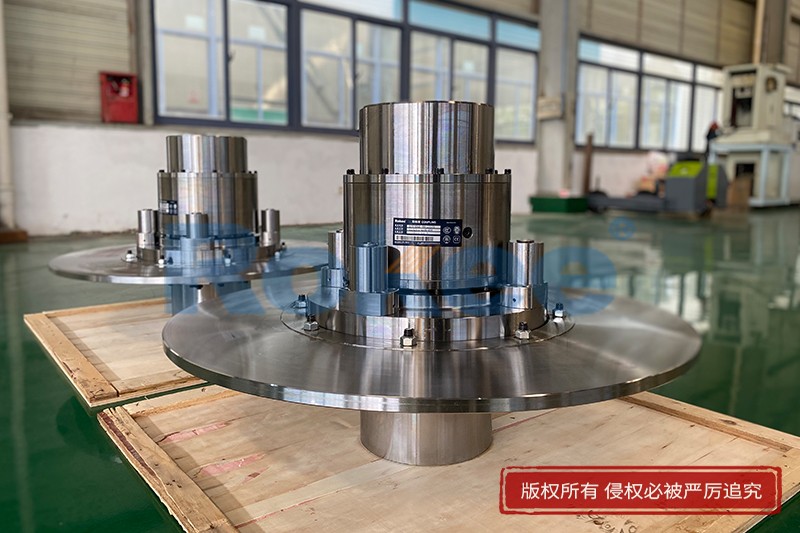
Rokee® Customized Gear Type Safety Coupling for Customers, Rokee® is a well-known high-quality supplier of couplings and technical services in China.
As a key safety component in the field of mechanical transmission, the gear type safety coupling cleverly combines the power transmission function of traditional toothed couplings with overload protection mechanisms, providing a reliable transmission solution for modern industrial equipment. This type of coupling not only inherits the high torque transmission capability and good deviation compensation characteristics of gear couplings, but also introduces intelligent overload protection function, which can automatically disconnect or limit torque transmission when the transmission system encounters abnormal loads, effectively preventing equipment damage and production accidents.
A toothed safety coupling is a mechanical device that combines transmission and protection functions. It achieves intelligent protection of the transmission system by integrating special safety mechanisms into traditional toothed couplings. The core value of this coupling is that it can automatically cut off power transmission or limit torque transmission when the transmission torque exceeds the preset safety threshold, thereby protecting valuable equipment such as motors and reducers from damage.
Compared with traditional safety devices, toothed safety couplings have unique advantages. It is different from ordinary safety pins or friction clutches, but achieves torque limitation through precision mechanical structures or electromagnetic control systems, with response time controlled within 10 milliseconds and simple and fast reset operation. At the same time, due to retaining the basic structure of the toothed coupling, it still has good axial, radial, and angular deviation compensation capabilities, allowing a maximum angular displacement of 6 degrees (recommended range of 1.5 ° to 2.5 °), and parallel offset compensation is usually 0.01-0.02 inches, which can adapt to installation errors that are difficult to avoid in practical engineering and shaft deformation during operation.
The design of the toothed safety coupling integrates two major systems: precision mechanical transmission and intelligent safety protection, and its structural complexity is much higher than that of ordinary couplings. A complete set of toothed safety couplings usually consists of four main parts: transmission module, overload detection module, separation execution module, and reset mechanism. Each part has been carefully designed and optimized to ensure efficient power transmission during normal operation and to quickly and reliably cut off transmission in case of overload.
The transmission module is the power transmission center of the toothed safety coupling, retaining the basic characteristics of traditional toothed couplings. This module includes precision machined inner gear rings and outer gear shaft sleeves, with mostly drum shaped tooth designs to enhance compensation capabilities. In terms of material selection, transmission components usually use high-strength alloy steels such as 42CrMo4, 35CrMo, etc. After quenching and tempering heat treatment, the tooth surface is then subjected to carburizing quenching or nitriding treatment, and the surface hardness can reach HRC58-62, ensuring wear resistance and fatigue strength. Unlike ordinary gear couplings, the transmission module of the safety coupling is pre installed with weak links or separable mechanisms. These design points maintain rigid connections under normal torque, but once the torque exceeds the limit, relative displacement or disconnection occurs.
The overload detection module is the "nervous system" of the safety coupling, responsible for real-time monitoring of the transmission torque status. Mechanical detection usually adopts a spring preloading structure, which sets the triggering threshold by precisely calculating the spring stiffness and preloading shrinkage; Electronic detection uses strain gauges or electromagnetic sensors, with a measurement accuracy of ± 0.5% FS. The latest intelligent coupling combines the two to form a redundant detection system, greatly improving reliability. The separation execution module is the 'muscle system' of the safety coupling, which quickly acts to cut off power transmission when overload is detected. Common execution methods include mechanical ejector pin, electromagnetic clutch disengagement, hydraulic piston action, etc. High end products can complete the disengagement action within 10 milliseconds.
The design of the reset mechanism directly affects the convenience of using the coupling. Simple models require manual intervention for resetting, such as reinstalling shear pins or adjusting springs; The semi-automatic type can be restored by simple operation (such as rotating the adjustment ring); The fully automatic type will automatically re engage after the torque returns to normal. Modern gear type safety couplings are increasingly emphasizing the convenience of resetting. Some products have achieved "tool free" resetting, which only requires tapping the drive ball or reloading with a lever to resume operation, greatly reducing downtime.
The protection mechanism of the gear safety coupling is based on the principle of torque balance, and its working principle can be divided into three typical stages. During normal operation, when the transmission torque is less than the preset safety value, the coupling maintains a rigid connection state. At this time, the spring preload or electromagnetic suction force is greater than the separation force generated by the working torque, and the inner and outer teeth remain fully engaged. The power transmission efficiency can reach over 99%. In this state, the performance of the coupling is no different from that of a regular toothed coupling, but the internal detection system continuously monitors torque changes.
When overload occurs, the separation force generated by the working torque exceeds the preset threshold, and the protection mechanism is immediately triggered. In mechanical couplings, this process is manifested as the driving ball overcoming the spring force and beginning to slide; In electromagnetic couplings, it is manifested as a decrease in magnetic force caused by changes in control current. After triggering, the actuator quickly acts to interrupt the transmission path or generate controllable slip, limiting the transmitted torque within a safe range. This process is usually completed within 10 milliseconds, much faster than the fracture response time of traditional insurance pins, and can effectively prevent secondary damage caused by inertial loads.
The reset phase is a unique manifestation of the value of safety couplings. After the dangerous working condition is lifted, it can resume operation without replacing any parts. Mechanical design achieves reset through natural return of elastic elements or simple manual operation; Intelligent products can automatically detect the system status and automatically reconnect after confirming safety.
According to different protection mechanisms, structural forms, and application scenarios, tooth type safety couplings have developed various types with unique features, forming a complete product series. There are significant differences in triggering accuracy, response speed, reset mode, and torque capacity among different types of toothed safety couplings. Understanding these characteristics is crucial for proper selection and system integration.
Over the years, with excellent quality, we have been continuously providing many coupling products of various categories and uses complying with multiple standards and a full range of services, from the product selection to final installation and operation, for the industry fields of ferrous metallurgy, nuclear power, gas turbine, wind power, ropeway construction, lifting transportation, general equipment, etc. We strictly comply with quality system requirements and implement the whole process control to become a reliable and trustworthy partner of customers.
URL: https://m.rokee.com/coupling-cases/gear-type-safety-coupling.html