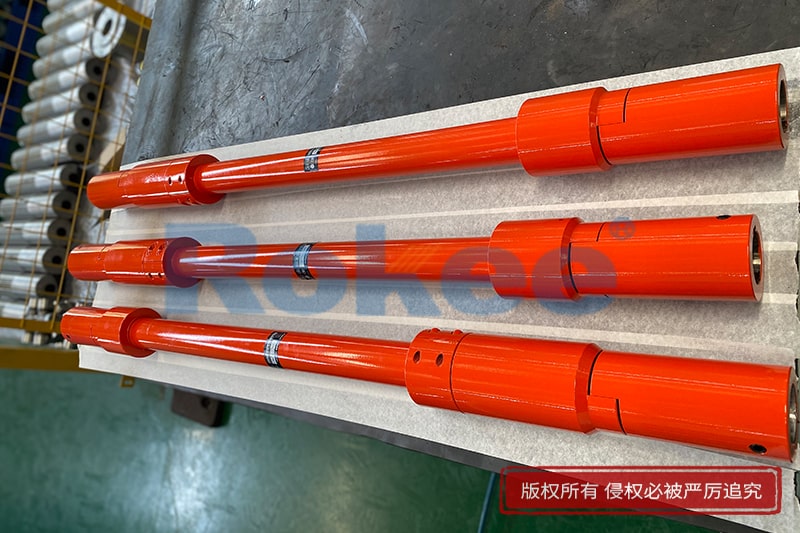
Rokee® Customized Drive Shafts for Customers, Rokee® is a well-known high-quality supplier of couplings and technical services in China.
As a key link in power transmission, the drive shaft plays a pivotal role in the field of mechanical engineering. Essentially, a drive shaft is a mechanical component used to connect different axes and transmit rotational power and torque, effectively transferring power from the driving end (such as an engine or motor) to the driven end (such as wheels or working mechanisms). The design and manufacturing level of the drive shaft directly affects the efficiency, reliability, and service life of the entire transmission system.
According to their elastic properties, drive shafts are mainly divided into two categories: rigid universal joint drive shafts and flexible universal joint drive shafts. The rigid universal joint drive shaft relies on the hinge type connection of components to transmit power, and has the characteristics of simple structure and high transmission efficiency; The flexible universal joint drive shaft transmits power through elastic elements and also has a buffering and vibration reducing effect, which can better adapt to the power transmission requirements under complex working conditions. This classification method reflects the fundamental differences in the power transmission mode of the drive shaft.
According to the angular velocity characteristics, drive shafts can be further divided into three types: non constant velocity universal joints, quasi constant velocity universal joints, and constant velocity universal joints. During the transmission process of non-uniform universal joints (such as common cross axis universal joints), the instantaneous angular velocities of the driven shaft and the driving shaft are not equal, but the average rotational speed remains consistent; Quasi constant velocity universal joints (such as double joint universal joints and three pin shaft universal joints) approximate constant velocity transmission through special design; Constant velocity universal joints (such as cage type universal joints and fork type universal joints) can ensure that the main and secondary shafts maintain the same angular velocity at any working angle, which makes them irreplaceable in applications such as steering drive axles.
From the perspective of torque transmission capability, drive shafts can be divided into multiple levels such as micro vehicle drive shafts, light vehicle drive shafts, medium vehicle drive shafts, heavy-duty vehicle drive shafts, and engineering vehicle drive shafts. Different grades of drive shafts have significant differences in material selection, structural design, and manufacturing processes to meet the requirements of various load conditions.
Over the years, with excellent quality, we have been continuously providing many coupling products of various categories and uses complying with multiple standards and a full range of services, from the product selection to final installation and operation, for the industry fields of ferrous metallurgy, nuclear power, gas turbine, wind power, ropeway construction, lifting transportation, general equipment, etc. We strictly comply with quality system requirements and implement the whole process control to become a reliable and trustworthy partner of customers.