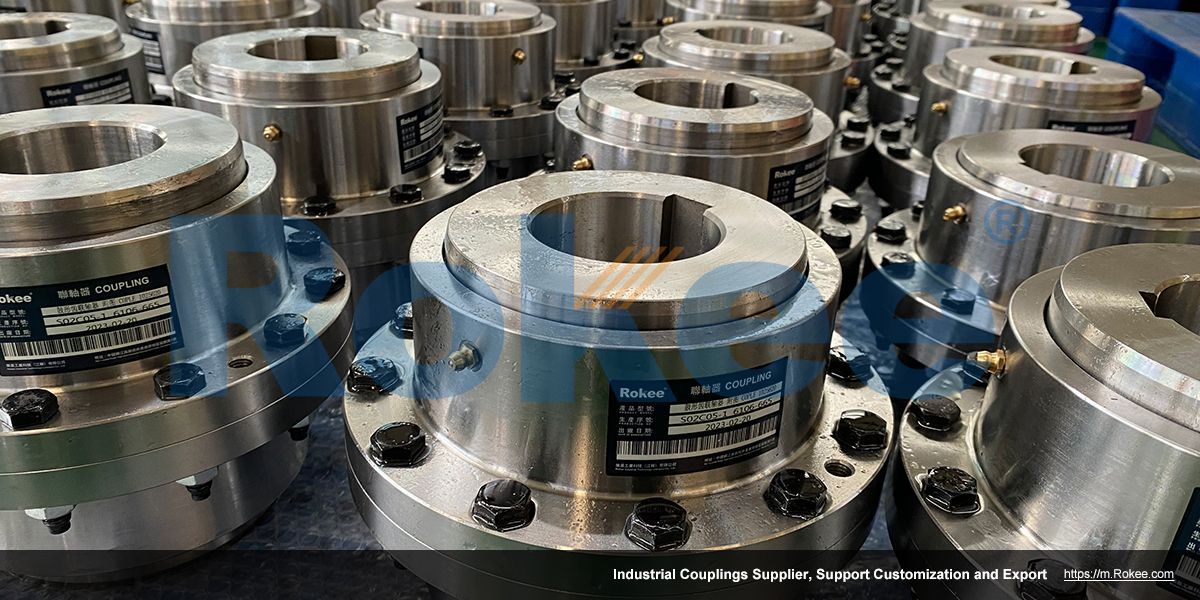
Low Speed Toothed Coupling
Low Speed Toothed Coupling is a widely used mechanical transmission component in the industrial field, with exquisite design and compact structure. It achieves smooth and unobstructed rotation between two shafts through precise gear meshing.
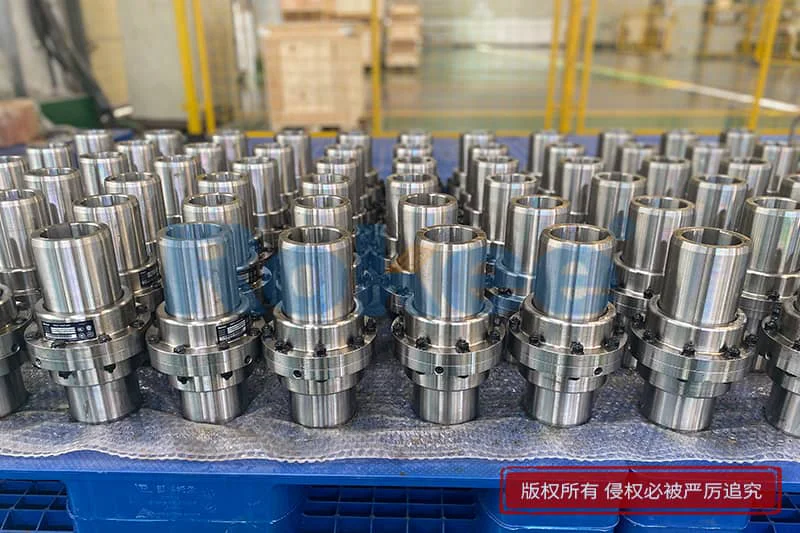
The low-speed gear coupling is mainly composed of internal gear rings, flange half couplings with external teeth (external gear shaft sleeves), and end caps. Among them, the external teeth are divided into two types: straight teeth and drum teeth. Drum shaped teeth are made by shaping the outer teeth into a spherical surface, with the center of the spherical surface on the gear axis. This design can improve the contact conditions of the teeth, enhance the ability to transmit torque, and allow for greater angular displacement.
Under low-speed heavy load conditions, low-speed gear couplings transmit torque and rotational motion through the meshing of inner and outer teeth. When there is relative displacement between the two axes, the tooth surfaces of the inner and outer teeth will periodically undergo axial relative sliding. In order to ensure the normal operation and prolong the service life of the coupling, it is necessary to work under good lubrication and sealing conditions.
Product Features
High bearing capacity: Low Speed Toothed Couplings can withstand large loads and are suitable for shaft transmission under low-speed heavy load conditions.
Good compensation performance: Especially for drum toothed couplings, their angular compensation capability is greater than that of straight toothed couplings, allowing for a certain degree of relative offset and inclination between the two shafts.
Compact structure: small radial size, occupying less space, easy to install and maintain.
Reliable work: After precision machining and dynamic balance testing, it ensures smooth and reliable transmission.
Low Speed Toothed Couplings are widely used in industries with low-speed and heavy-duty conditions such as metallurgy, mining, and lifting and transportation, as well as in industries such as petroleum, chemical, and general machinery. Especially in transmission systems that require bearing large loads and allowing for certain axis deviations, low-speed gear couplings demonstrate their unique advantages.
When installing low-speed gear couplings, the following points should be noted:
Check the meshing of the coupling teeth to ensure that the contact area along the tooth height is not less than 50% and along the tooth width is not less than 70%. There should be no severe pitting, wear, or cracks on the tooth surface.
The full circle runout and end face circle runout of the outer gear ring of the coupling should be controlled within a certain range to ensure the smoothness of the transmission.
If it is necessary to remove the ring gear, special tools should be used to avoid knocking and causing the shaft to bend or be damaged.
When reinstalling the intermediate connecting tube or other components, they should be assembled according to the original markings and data to ensure the coaxiality and parallelism of the coupling.
In terms of maintenance, the lubrication condition should be regularly checked, and lubricants should be replenished or replaced in a timely manner; At the same time, check the wear of the tooth surface and promptly repair or replace severely worn components.
Low Speed Toothed Couplings play an important role in transmission systems under low-speed heavy load conditions due to their high load-bearing capacity, good compensation performance, compact structure, and reliable operation.
« Low Speed Toothed Coupling » Post Date: 2023/9/13
URL: https://m.rokee.com/blog/low-speed-toothed-coupling.html
- Tolerance Of Drum Gear Coupling
- Tooth Clearance Of Drum Gear Coupling
- Tooth Detachment Of Drum Gear Coupling
- Tooth Parameters Of Drum Gear Coupling
- Tooth Surface Hardness Of Drum Gear Coupling
- Transmission Efficiency Of Drum Gear Coupling
- Transmission Method Of Drum Gear Coupling
- Triangle Tooth Surface Of Drum Gear Coupling
- Type Of Drum Gear Coupling
- Types Of Drum Gear Couplings