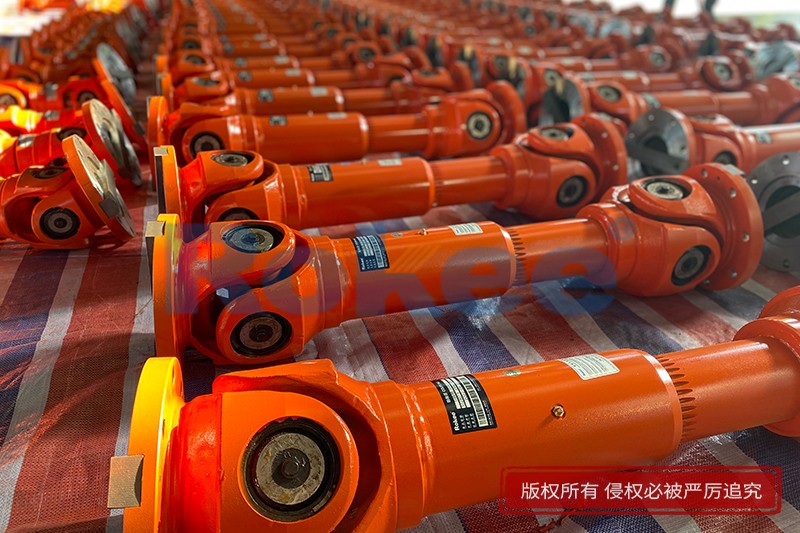
Rokee® Customized Cross Drive Shafts for Customers, Rokee® is a well-known high-quality supplier of couplings and technical services in China.
Cross drive shaft is a universal coupling device used to connect different axis drive shafts. In the field of mechanical engineering, it is regarded as a key basic component in the transmission system, with the main mission of solving the technical problem of misalignment of the axis during power transmission. This unique transmission mechanism can efficiently transmit torque and rotational motion within a certain angle range (usually 15 ° -20 °), while compensating for axial, radial, and angular installation deviations.
The working principle of the cross drive shaft is based on the motion characteristics of the spatial hinge mechanism. When the driving shaft rotates, it drives the driven shaft to rotate through the hinge action of the cross shaft. It is worth noting that a single cross axis universal joint has an inherent characteristic when transmitting rotational motion: when there is an angle between the two axes, the instantaneous angular velocity of the output shaft is not constant, but fluctuates periodically. This inequality is directly related to the size of the angle between the two axes - the larger the angle, the more pronounced the velocity fluctuations. To solve this problem, the "double universal joint" arrangement is commonly used in engineering practice, which involves using two universal joints in pairs and ensuring that the universal joint forks at both ends of the intermediate shaft are in the same plane, while also making the working angles of the two universal joints equal. This arrangement can effectively counteract the speed fluctuations of a single universal joint, achieving a nearly constant transmission effect.
The cross drive shaft is a precision designed mechanical system, and its structural composition reflects the wisdom of mechanical engineers in solving complex transmission problems. A typical cross drive shaft consists of three major functional components: the shaft tube assembly, the telescopic sleeve device, and the universal joint assembly, each of which carries an irreplaceable functional mission. A deep understanding of the structural characteristics and working principles of these components can help us comprehensively grasp the performance characteristics of the cross drive shaft.
The universal joint component is undoubtedly the core part of the cross drive shaft, and its structural complexity and manufacturing accuracy directly affect the reliability of the entire transmission system. This component mainly consists of four key elements: universal joint fork (also known as flange fork), cross shaft, needle roller bearing assembly, and sealing system. The universal joint fork is usually forged from high-quality medium carbon alloy steel and has a Y-shaped structure. The two fork arms are precision machined with bearing seat holes. As the hub of power conversion, the cross shaft has undergone ultra precision grinding treatment on its four journal surfaces, with a roughness controlled below Ra0.2, ensuring a perfect fit with the needle roller bearings. The cross shaft of modern high-performance transmission shafts often adopts a hollow structure design, which reduces weight without significantly reducing strength. The needle roller bearing assembly consists of dozens of precision needle rollers, bearing bowls, and multi lip rubber oil seals, which can provide maximum load-bearing capacity in a limited space. Of particular note is the sealing technology of bearings. High quality transmission shafts use multi-layer composite oil seals, even including PTFE coatings, which can effectively prevent grease leakage and pollutant invasion, greatly extending maintenance cycles.
The telescopic sleeve device is another ingenious design in the cross drive shaft, which solves the problem of axial dimension fluctuations caused by temperature changes and elastic deformation in the transmission system. The traditional telescopic sleeve consists of a spline shaft, a spline sleeve, and a dust cover, and the spline teeth are mostly rectangular. Modern advanced designs use high pressure angle involute short tooth splines, which have higher load-bearing capacity and better centering characteristics.
As the main part of the transmission shaft, the design consideration of the shaft tube assembly cannot be ignored. The transmission shaft tube is usually made of high-strength thin-walled steel pipe, and the optimized design of diameter and wall thickness gives it the best torsional stiffness to weight ratio. To meet the requirements of different working conditions, some specialized transmission shafts may use lightweight materials such as carbon fiber composite materials or aluminum alloys.
The reason why cross drive shafts can be widely used in many industrial fields is due to their unique technical characteristics and excellent performance advantages. These characteristics make it irreplaceable in transmitting power and adapting to complex working conditions. In depth analysis of these technical characteristics will help us fully utilize the performance potential of the cross drive shaft in practical applications.
Cross drive shafts have developed various structural forms based on different design characteristics and application requirements. Each type of drive shaft has its own strengths in mechanical characteristics, performance parameters, and applicable scenarios. Understanding the characteristics and applicable conditions of these types is crucial for selecting and optimizing transmission systems correctly. From an engineering application perspective, cross drive shafts can be classified according to multiple standards, each of which reflects specific technical characteristics and application considerations.
Over the years, with excellent quality, we have been continuously providing many coupling products of various categories and uses complying with multiple standards and a full range of services, from the product selection to final installation and operation, for the industry fields of ferrous metallurgy, nuclear power, gas turbine, wind power, ropeway construction, lifting transportation, general equipment, etc. We strictly comply with quality system requirements and implement the whole process control to become a reliable and trustworthy partner of customers.
URL: https://m.rokee.com/coupling-cases/cross-drive-shafts.html