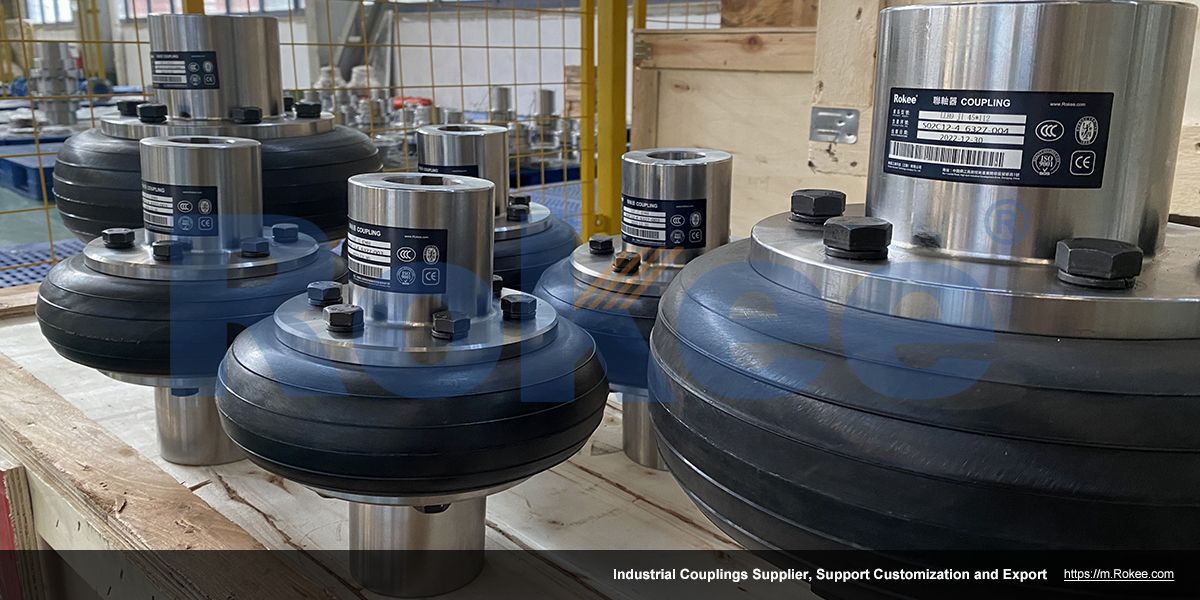
Rubber Tyre Couplings
Rubber Tyre Coupling adopts tyre body-shaped rubber elements, which are connected with two semi-couplings through bolts to realize torque transmission and displacement compensation. Tyre Coupling has high elastic performance, small torsional rigidity, strong damping capacity, large axial compensation capacity, and good damping performance.

UL Flexible Tyre Coupling adopts the structure of vulcanizing and bonding the tyre body with the metal connecting plate with threaded holes, which is then directly connected to the two semi-couplings by bolts for torque transmission and other displacement compensation.
The LLA Elastic Tyre Coupling uses two semi-couplings to connect both sides of the elastic tyre body through internal pressing plates and bolts, making it easy to replace the elastic tyre body.

Rubber tire coupling is a highly elastic coupling device that achieves dual functions of power transmission and system protection through unique tire shaped rubber components. As a key component of the mechanical transmission system, it can effectively absorb vibration and impact while transmitting torque, compensate for shaft offset, and is particularly suitable for harsh working conditions such as humidity, dust, impact vibration, and frequent start stop.
The typical structure of a rubber tire coupling consists of three main parts:
- Two flange half couplings with shaft holes: usually made of cast steel, cast iron, or 45 # steel, responsible for connecting the drive shaft and the driven shaft
- Tire like rubber elastomer: As a core functional component, it is tightly integrated with the internal steel skeleton through vulcanization process
- Connecting bolt assembly: Tighten the tire body to the flanges on both sides to form a complete torque transmission path
The advanced model adopts rubber composite material reinforced with nylon thread, with a mesh skeleton structure embedded inside, which not only maintains high elasticity but also greatly improves tear resistance. The tire body of UL type products is designed as a closed whole, while LLA type adopts an open structure for easy installation and maintenance under specific working conditions.
Torque transmission relies on the frictional force generated by the pre tightening force of the bolt: when the drive shaft rotates, the flange transmits torque to the tire body through the bolt, and the tire body undergoes controllable elastic deformation to transmit power to the other flange. This design allows for the transmission of torque while:
- Absorption of instantaneous impact through shear deformation of rubber
- Utilizing the damping properties of materials to consume vibration energy
- Compensate installation deviation with elastic deformation
The tire body of high-quality products adopts a mixed formula of natural rubber and synthetic rubber, with nylon fiber layers arranged in the warp and weft directions inside to ensure uniform stress distribution when subjected to torsional loads and avoid early failure caused by local overheating.
The excellent compensation capability of rubber tire couplings comes from the three-dimensional deformable characteristics of the elastic body:
- Axial compensation: achieved through the expansion and contraction of the corrugated structure of the tire body
- Radial compensation: relies on the lateral deformation ability of rubber
- Angular compensation: utilizing the conical deformation characteristics of the tire body
Rubber tire couplings are widely used in multiple industries:
- Metallurgical equipment: LLB type performs outstandingly in heavy-duty and high-temperature applications such as rolling mills and continuous casting machines
- Mining machinery: crushers, ball mills and other high impact environments, UL type has good durability
- Paper industry: Large diameter drum drive requires compensation for thermal expansion
- Energy sector: Long axis systems such as fans and pump units, compensating for foundation settlement
- Transportation: Ship propulsion system, seawater corrosion resistant model
Technical limitations that need to be noted in practical applications:
- Larger size: The radial size is usually 30-50% larger than the gear coupling
- Axial force issue: Centrifugal force causes additional axial force at high speeds, requiring special design to counteract it
- Temperature limit: Standard rubber materials are not suitable for extreme temperature environments
- Torque capacity: usually not exceeding 25000 N · m, not suitable for ultra heavy equipment
The correct selection and use of rubber tyre couplings can significantly improve the reliability of the transmission system, reduce maintenance costs, and are particularly suitable for the transformation and upgrading needs of China's manufacturing industry. It is recommended that users consider technical parameters, operating conditions, and service support comprehensively when selecting, and work closely with professional suppliers to fully leverage the modern value of this classic transmission component.
In the realm of mechanical transmission systems, the seamless transfer of power from a driving source to a driven component is paramount to the efficient and reliable operation of countless industrial, automotive, and agricultural applications. Among the diverse array of coupling devices designed to facilitate this critical function, Rubber Elastic Tyre Couplings and Flexible Tire Couplings stand out as versatile and indispensable components. These two types of couplings, often referenced interchangeably due to their similar core functionalities and structural characteristics, play a vital role in mitigating the challenges inherent in mechanical power transmission, such as misalignment, vibration, and shock loads.


To begin with, it is essential to clarify the core definitions and distinguishing features of Rubber Elastic Tyre Couplings and Flexible Tire Couplings. At their essence, both couplings are designed to connect two rotating shafts while accommodating relative displacement between them, thereby ensuring the smooth transmission of torque. The term "Rubber Elastic Tyre Coupling" emphasizes the use of rubber as the primary elastic element, which is shaped into a tyre-like structure to provide flexibility and damping capabilities. Similarly, "Flexible Tire Coupling" highlights the tyre-shaped flexible component that serves as the key interface between the driving and driven shafts. While there may be subtle variations in design terminology across different manufacturing contexts, the two designations generally refer to couplings that utilize a rubber tyre element to achieve flexibility, making them functionally analogous for most practical purposes. The core advantage of this tyre-based design lies in its ability to combine the rigidity required for torque transmission with the elasticity necessary to absorb and dissipate harmful mechanical forces, thereby protecting both the coupling itself and the connected machinery.
The structural composition of Rubber Elastic Tyre Couplings and Flexible Tire Couplings is relatively straightforward yet ingeniously engineered to fulfill their dual role of torque transmission and vibration damping. A typical configuration consists of three main components: two metal flanges (or hubs), a rubber tyre element, and connecting fasteners (such as bolts and nuts). The metal flanges are precision-machined to fit securely onto the driving and driven shafts, usually via keyway connections, interference fits, or set screws to ensure a tight and slip-free joint. The rubber tyre, which forms the central flexible element, is mounted between these two flanges. The tyre itself is often designed with a hollow, cylindrical structure that mimics the shape of a small tyre, with inner and outer surfaces that attach to the flanges. In some designs, the rubber tyre may feature reinforcing layers, such as fabric or steel cords, embedded within the rubber matrix to enhance its tensile strength and torque-bearing capacity without compromising its elastic properties. The connecting fasteners pass through the flanges and the rubber tyre, securing the assembly together while allowing a degree of relative movement between the flanges to accommodate misalignment.
The material selection for Rubber Elastic Tyre Couplings and Flexible Tire Couplings is a critical factor that directly influences their performance, durability, and application suitability. The rubber used in the tyre element is carefully chosen based on the specific operating conditions of the coupling. Common rubber materials include natural rubber, nitrile rubber (NBR), ethylene-propylene-diene monomer (EPDM) rubber, and silicone rubber. Natural rubber offers excellent elasticity, high tensile strength, and good resistance to fatigue, making it suitable for general-purpose applications with moderate operating temperatures and minimal exposure to harsh chemicals. Nitrile rubber, on the other hand, exhibits superior resistance to oil, fuel, and grease, making it ideal for applications in automotive and industrial settings where contact with petroleum-based products is inevitable. EPDM rubber is renowned for its excellent resistance to weathering, ozone, and high temperatures, making it suitable for outdoor applications or environments with extreme temperature fluctuations. Silicone rubber, while more expensive, provides exceptional high-temperature resistance and good electrical insulation properties, making it suitable for specialized applications such as in high-temperature industrial processes or electrical machinery. The metal components of the coupling are typically manufactured from high-strength carbon steel, alloy steel, or aluminum alloy. Carbon steel and alloy steel offer high rigidity and torque-bearing capacity, making them suitable for heavy-duty applications, while aluminum alloy is used in lightweight applications where reducing overall system weight is a priority.
The working principle of Rubber Elastic Tyre Couplings and Flexible Tire Couplings revolves around the elastic deformation of the rubber tyre element. When torque is transmitted from the driving shaft to the coupling, the metal flange attached to the driving shaft exerts a rotational force on the rubber tyre. The rubber tyre, being elastic, deforms slightly under this force and transfers the torque to the driven flange and subsequently to the driven shaft. This elastic deformation is key to the coupling's ability to accommodate various types of misalignment between the driving and driven shafts, including axial misalignment (movement along the shaft axis), radial misalignment (offset perpendicular to the shaft axis), and angular misalignment (tilt between the two shafts). Without this flexibility, even minor misalignment could lead to excessive stress on the shafts, bearings, and other components, resulting in premature failure. Additionally, the rubber tyre element acts as a vibration damper. As the shafts rotate, any vibrations generated by the driving source (such as an electric motor or internal combustion engine) are absorbed by the rubber tyre, which converts the vibrational energy into heat and dissipates it. This damping effect not only reduces noise levels but also protects the driven machinery from the harmful effects of vibration, such as fatigue and loosening of fasteners.
One of the most notable performance advantages of Rubber Elastic Tyre Couplings and Flexible Tire Couplings is their excellent shock absorption capability. In many mechanical systems, especially those involving intermittent loads or sudden starts and stops (such as in pumps, compressors, and conveyors), shock loads are inevitable. These shock loads can cause severe damage to the transmission system if not properly mitigated. The rubber tyre element in these couplings is highly effective at absorbing and dissipating shock energy, thereby reducing the impact on the connected shafts, bearings, and machinery. This shock absorption capability not only extends the service life of the transmission system but also improves the overall stability and reliability of the equipment. Another significant advantage is their ability to compensate for misalignment, as mentioned earlier. Unlike rigid couplings, which require precise alignment of the shafts and can only accommodate minimal misalignment, Rubber Elastic Tyre Couplings and Flexible Tire Couplings can tolerate relatively large amounts of misalignment, reducing the installation and maintenance requirements. This flexibility also makes them suitable for applications where thermal expansion and contraction of the shafts may occur, as the rubber tyre can accommodate the resulting axial movement.
Furthermore, Rubber Elastic Tyre Couplings and Flexible Tire Couplings offer excellent noise reduction properties. The rubber tyre element acts as a sound insulator, dampening the noise generated by the rotating shafts and the transmission of power. This is particularly beneficial in industrial environments where noise pollution is a concern, as it helps to create a quieter and more comfortable working environment. Additionally, these couplings are relatively simple in design and easy to install and maintain. The assembly process typically involves attaching the flanges to the shafts, positioning the rubber tyre between the flanges, and securing the fasteners. Maintenance requirements are minimal, usually limited to regular inspections of the rubber tyre for signs of wear, cracking, or degradation, and replacing the tyre element when necessary. The simplicity of the design also means that replacement parts are readily available and relatively inexpensive, reducing downtime and maintenance costs.


The application range of Rubber Elastic Tyre Couplings and Flexible Tire Couplings is extremely wide, spanning numerous industries and sectors. In the industrial sector, they are commonly used in pumps, compressors, fans, blowers, conveyors, mixers, and agitators. For example, in a centrifugal pump system, the coupling connects the electric motor to the pump shaft, accommodating any misalignment between the two shafts and absorbing the vibrations generated by the motor, thereby ensuring the smooth operation of the pump. In the automotive industry, these couplings are used in various components, such as drive shafts, transmissions, and auxiliary systems. For instance, in some commercial vehicles, Rubber Elastic Tyre Couplings are used to connect the engine to the transmission, absorbing the shock loads generated during gear changes and reducing vibration transmission to the vehicle chassis. In the agricultural sector, they are employed in farm machinery such as tractors, harvesters, and irrigation pumps, where they can withstand the harsh operating conditions, such as dust, dirt, and varying temperatures, while accommodating the misalignment that may occur due to the uneven terrain and the flexible mounting of the machinery.
Other notable applications include marine propulsion systems, where the couplings connect the ship's engine to the propeller shaft, accommodating the misalignment caused by the movement of the ship's hull and absorbing the vibrations generated by the engine. They are also used in renewable energy systems, such as wind turbines, where they connect the turbine rotor to the generator, absorbing the fluctuating torque and vibration generated by the wind and ensuring the stable transmission of power. Additionally, in the mining industry, these couplings are used in heavy-duty equipment such as crushers, grinders, and conveyors, where they can withstand the high torque and shock loads associated with mining operations.
Proper installation and maintenance are crucial to ensuring the optimal performance and long service life of Rubber Elastic Tyre Couplings and Flexible Tire Couplings. During installation, the first step is to ensure that the shafts are clean and free from any dirt, rust, or debris, as this can affect the fit between the flanges and the shafts. The flanges should be mounted onto the shafts correctly, ensuring that they are properly aligned (as much as possible before installing the rubber tyre) and secured tightly using the appropriate fasteners. It is important to follow the manufacturer's recommended torque specifications when tightening the fasteners to avoid over-tightening, which can damage the flanges or the rubber tyre, or under-tightening, which can result in slippage. After mounting the flanges, the rubber tyre should be positioned between them, ensuring that it is properly seated and aligned. The connecting fasteners between the flanges and the tyre should then be tightened evenly to ensure that the load is distributed uniformly across the tyre.
Regular maintenance inspections should be conducted to monitor the condition of the coupling. These inspections should include checking the rubber tyre for signs of wear, cracking, bulging, or degradation. If any of these signs are present, the tyre should be replaced immediately to prevent failure. The fasteners should also be checked regularly to ensure that they are tight and secure, as vibration can cause them to loosen over time. Additionally, the alignment of the shafts should be checked periodically, as misalignment can increase the stress on the coupling and reduce its service life. In environments where the coupling is exposed to dirt, dust, or moisture, it may be necessary to clean the coupling regularly to prevent the accumulation of debris, which can accelerate wear. Lubrication is generally not required for the rubber tyre element, but if the flanges have bearing surfaces, they may need to be lubricated periodically according to the manufacturer's recommendations.
The future development of Rubber Elastic Tyre Couplings and Flexible Tire Couplings is likely to be driven by advancements in material science, manufacturing technology, and the increasing demand for more efficient and reliable mechanical systems. One area of focus is the development of new rubber materials with enhanced properties, such as higher tensile strength, better resistance to extreme temperatures and chemicals, and improved fatigue life. For example, the development of nanocomposite rubber materials, which incorporate nanoparticles into the rubber matrix, has the potential to significantly improve the mechanical and thermal properties of the tyre element. Another area of development is the optimization of the coupling design using computer-aided design (CAD) and finite element analysis (FEA) tools. These tools allow engineers to simulate the performance of the coupling under various operating conditions, enabling them to design more efficient and lightweight couplings that can withstand higher torque and misalignment while reducing material usage.
Manufacturing technology advancements, such as 3D printing, may also play a role in the future production of these couplings. 3D printing allows for the production of complex geometries that are difficult or impossible to achieve with traditional manufacturing methods, enabling the design of more efficient and customized couplings. Additionally, 3D printing can reduce production time and costs, especially for small-batch or custom-made couplings. The increasing focus on energy efficiency and sustainability is also likely to influence the development of Rubber Elastic Tyre Couplings and Flexible Tire Couplings. Manufacturers may strive to develop couplings that are more energy-efficient, with lower friction losses, and made from environmentally friendly materials that are recyclable or biodegradable.
Another emerging trend is the integration of smart technologies into the couplings. For example, the incorporation of sensors to monitor the condition of the rubber tyre, such as its temperature, deformation, and wear, can enable predictive maintenance. These sensors can transmit real-time data to a monitoring system, allowing operators to detect potential issues before they lead to failure, thereby reducing downtime and maintenance costs. Additionally, the use of IoT (Internet of Things) technology can enable remote monitoring and control of the couplings, making it easier to manage large fleets of machinery equipped with these components.
In conclusion, Rubber Elastic Tyre Couplings and Flexible Tire Couplings are essential components in modern mechanical transmission systems, offering a unique combination of flexibility, torque transmission capability, vibration damping, and shock absorption. Their simple yet effective design, coupled with the versatility of rubber materials, makes them suitable for a wide range of applications across various industries. Proper material selection, installation, and maintenance are key to ensuring their optimal performance and long service life. As technology continues to advance, these couplings are likely to become even more efficient, reliable, and versatile, with new materials and smart technologies driving their evolution. Whether in industrial machinery, automotive systems, agricultural equipment, or renewable energy applications, Rubber Elastic Tyre Couplings and Flexible Tire Couplings will continue to play a critical role in ensuring the smooth and reliable operation of mechanical systems for years to come.